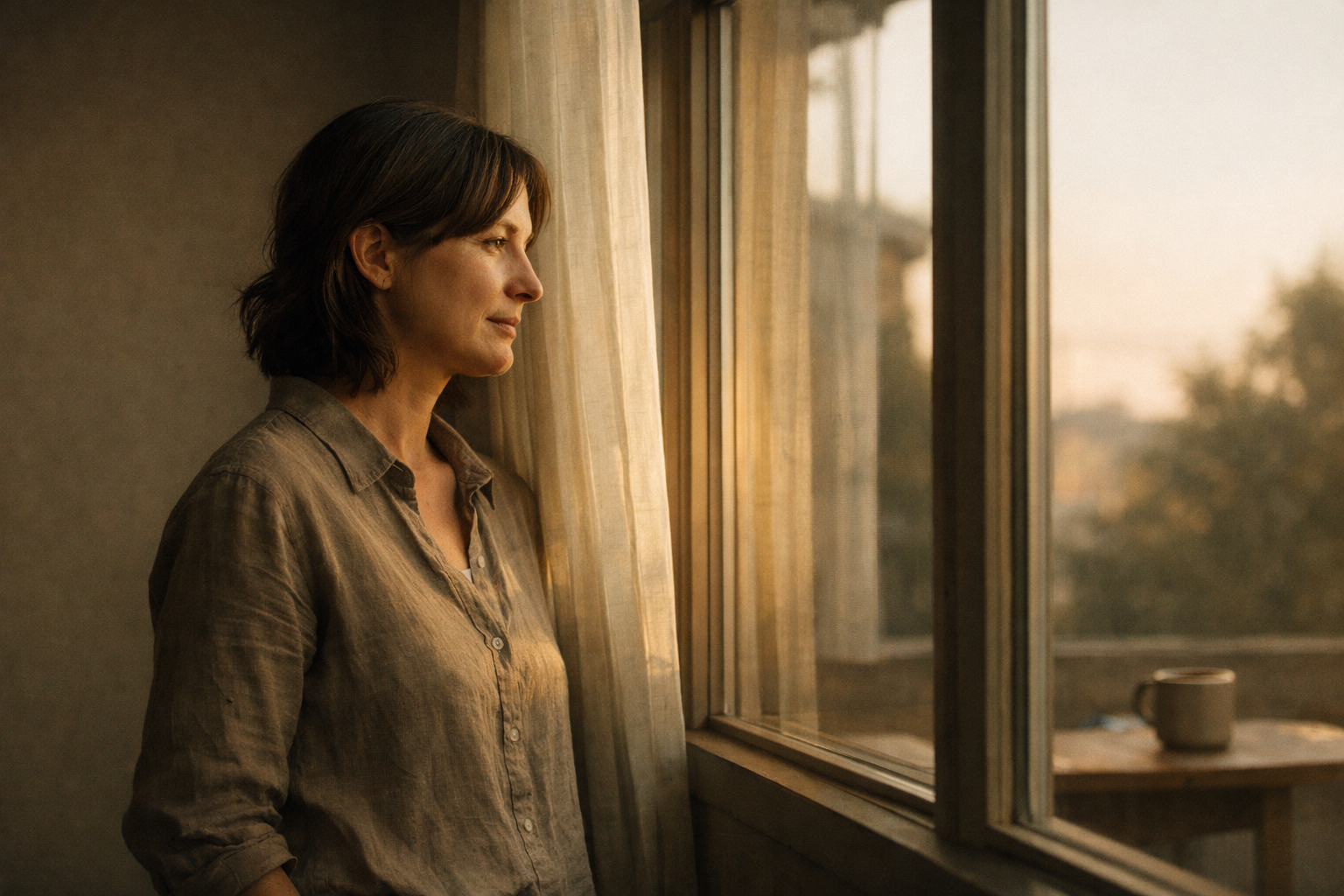
This is about what happens after motherhood changes shape — when children grow, distance becomes natural, and certain truths arrive a little later than we would have chosen.
It does not begin when they are small, because in those years life moves too quickly for reflection to settle anywhere for long. You are occupied with what needs to be done, what needs to be held together, what cannot wait, and even when doubt appears, it is brief and quickly replaced by something more immediate.
The questions come later, and they do not arrive loudly. They appear in ordinary moments, almost politely, as if they had been waiting for the right time. A sentence said without weight, a detail mentioned in passing, and suddenly something shifts. You are no longer only in the present. You are looking back, whether you intended to or not.
Not long ago, I had a conversation with my son that stayed with me, not because it was difficult in any obvious way, but because it was quietly precise. He told me that, over the years, there were moments when both of them felt drawn into the space between their parents, listening to things that, at the time, were not meant for them to carry.
He did not say it with blame. There was no sharpness in it. If anything, there was care.
But the moment he said it, something in me settled differently. Because in my understanding, I had been careful. I believed I had kept those lines clear, that I had protected them from exactly that kind of emotional overlap.
And yet, from where he stood, the experience had been different.
I apologized, because I had not seen it, and that mattered more than defending the intention. And still, almost instinctively, another thought followed close behind:
So this is where I got it wrong.
He noticed it immediately, perhaps even before I fully did, and softened the moment in a way only children can when they sense they have touched something sensitive. He said it was only one thing, that everything else had been good, that I had been a good mother.
It was said simply, without effort.
And yet, it is curious how the mind works.
It does not always stay with the many things that went well. It returns, instead, to the one detail that feels unfinished. This, I have come to understand, is one of the quieter realities of motherhood. Not the effort itself, not the years of doing and holding and showing up, but the way a single realization can take on a weight far greater than it deserves, simply because it reveals something we did not know at the time.
Our conversations now are different. There is an ease that comes when roles soften and something more equal takes their place. We speak openly, but also more carefully, not out of distance, but out of understanding.
They do not always have space for everything I might wish to share, especially when it carries a weight they cannot influence. It is not a lack of care, but a quiet boundary, a way of protecting their own steadiness.
And this, too, took a moment to understand. Because there is a part of motherhood that expects to remain the place where everything can be said.
But there is another truth that arrives later.
Not everything we carry needs to be passed on, even to those closest to us.
Looking back, I can see that what felt, at the time, like speaking honestly may not always have been light to receive. Not because it was wrong, but because children, even when they grow, do not stand outside of what we share. They stand within it.
And what we place into that space does not simply pass through. It settles.
This is something we rarely recognize while we are living it.
Because we are not observing ourselves from a distance. We are responding, adjusting, moving through real moments without the luxury of knowing how they will be remembered later.
From a more grounded understanding, it becomes clear that children are not neutral listeners within a family dynamic. They do not receive things as detached observers. They absorb, interpret, and often carry more than we intend.
Not dramatically. Not all at once. But slowly, over time.
And so, many mothers find themselves here, not questioning the obvious things, but noticing the subtle ones. Not what was done deliberately, but what happened quietly alongside everything else.
This does not mean you failed.
It means you lived motherhood as it actually is — not as an ideal, but as something shaped by circumstances, emotions, and moments that did not come with instructions.
The difficulty is that motherhood is only fully understood in reverse.
When you are in it, you decide without knowing.
When you look back, you evaluate with knowledge you did not have then.
So the question appears, almost inevitably:
Did I fail as a mother?
But the question itself asks for something that was never possible to give.
A clean answer.
There were moments that could have been different.
There are things you see now that you did not see then.
That is true.
But there were also years of presence, of consistency, of care that do not present themselves loudly, because they were simply part of everyday life.
What your child offered in that moment was not a judgment.
It was a detail.
One piece, placed gently, within a much larger experience.
And the shift lies here.
Not in dismissing it, and not in allowing it to define everything, but in placing it where it belongs.
As part of the whole.
Not the conclusion of it.
Because motherhood was never a finished result.
It was lived forward, understood later.
And the most honest truth may be this.
The story you tell yourself now, shaped by hindsight, may not be the same story your children carry.
And somewhere between those two versions, without drama and without final verdict, is what motherhood actually was.
Not perfect.
Not failed.
Simply human.



 English
  Polish