When Winter Took Over the City - part 4 (d)
Before You Read
Welcome back to The Childhood We Never Thought to Miss.
If you’re joining my memoir for the first time, I warmly invite you to begin with Part 1, where this journey through childhood in Poland begins.
In the previous chapter, Learning to Notice, we wandered through the park where simple walks quietly became life’s first lessons. This time, the seasons change. Winter arrives in Łódź, covering the city in deep snow and turning ordinary streets into places of adventure, laughter and unforgettable memories.
I hope this chapter takes you back to a winter you may have forgtten to remember.
…….
There was something magical about waking up on a winter morning before I had even opened my eyes. Children somehow know when the world has changed. The usual sounds drifting through the window seemed quieter, softer somehow, as though somebody had wrapped the whole city in a thick white blanket overnight. Before my feet even touched the floor, I was already pulling the curtain aside with more hope than certainty, praying to see what every child longed for.
Snow.
Not the sad little dusting that disappeared before lunchtime, but proper snow. The kind that buried rooftops, completely covered the cars so they looked as though someone had sculpted them out of snow, and transformed every familiar street into a place that looked completely new. Early the next morning people would already be outside, scraping thick layers of snow from their windscreens, clearing the pavements in front of their homes and scattering sand and salt wherever the ground had turned to ice. It was simply what everyone did after a heavy snowfall. Even so, someone usually ended up slipping. Whenever that happened, I would be rolling with laughter, and so would everyone else. Well… almost everyone. The person lying on the ground wasn’t always quite so amused, although plenty of them eventually laughed along with the rest of us.
On mornings like that, the whole neighborhood seemed to breathe differently. Even the old grey buildings around us looked gentler beneath their white coats, as though winter had forgiven them for being ordinary. For a few precious hours, before the traffic returned and footprints began to criss-cross the fresh snow, it felt as though the city belonged to winter alone.
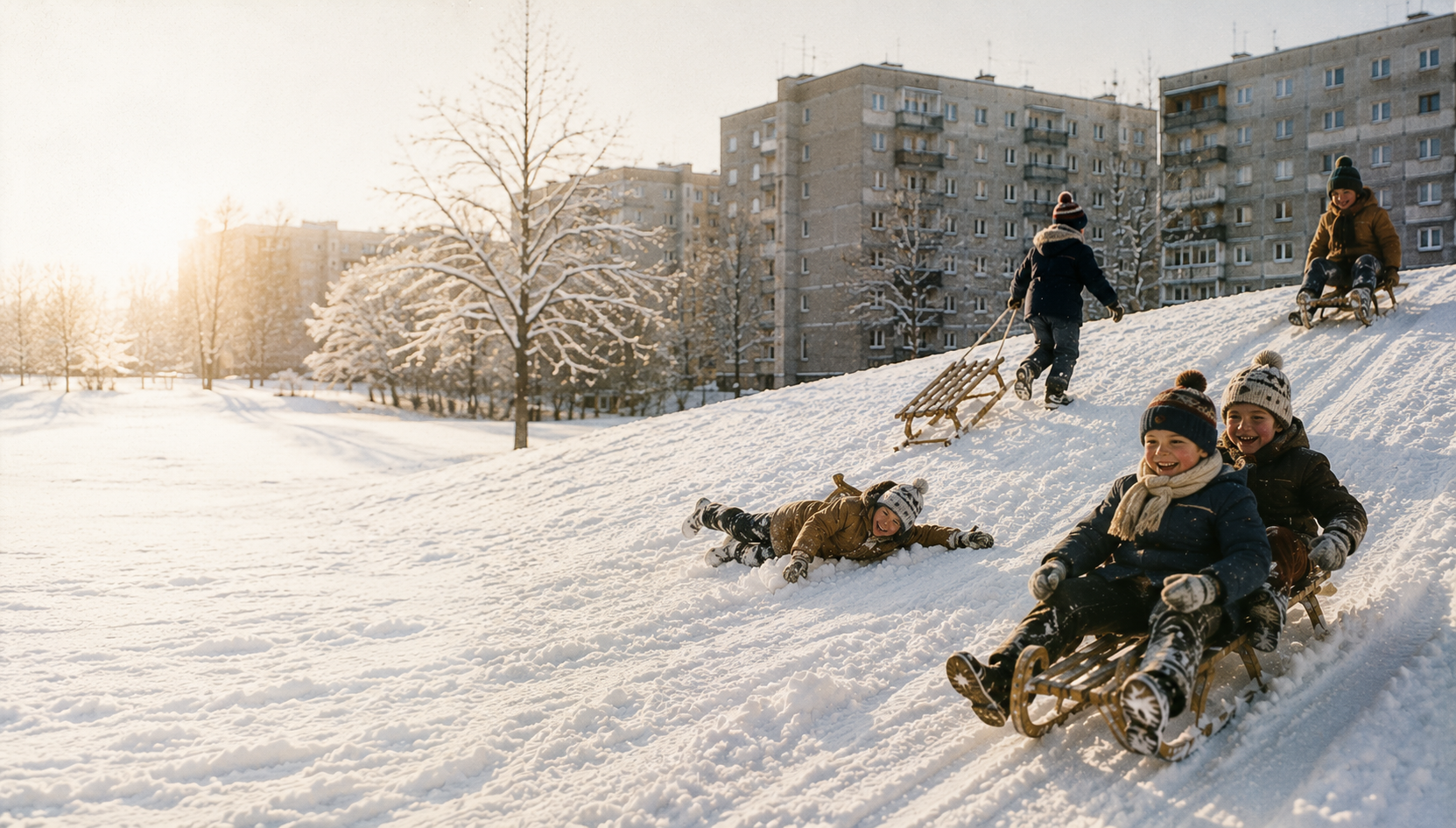
The best part was knowing that somewhere not too far from home, our hill would be waiting.
To this day I couldn’t tell you whether it was actually as enormous as I remember or whether it simply looked that way through the eyes of a little girl. Childhood has a wonderful habit of making everything bigger than life. Hills become mountains, puddles become lakes and the walk home always seems much longer than the walk there. Whatever its real size, to us it was magnificent. Standing at the top and looking down made my stomach flutter with that delicious mixture of excitement and just the tiniest hint of fear. It was high enough to make you wonder if perhaps this time you might actually fly.
My parents always came with us.
One waited at the top.
The other stood near the bottom.
Not because they wanted to spoil our adventure, but because they knew perfectly well that once the sled began its journey, there was very little anyone could do to negotiate with it. Gravity had already made up its mind.
I would sit on the sled, wrapped up so tightly that moving my arms felt like a challenge in itself, my woolen scarf covering half my face while my hat seemed determined to slide over my eyes at the least convenient moment. Someone gave me one final little push and suddenly there was no turning back.
Down we went.
Faster.
Faster.
The freezing air rushed against my cheeks until they stung, tears streamed from my eyes whether I wanted them to or not and laughter escaped so freely that it disappeared somewhere behind me before I could even hear it. The runners skimmed across the packed snow with that wonderful scraping sound that every child of my generation would recognize instantly, while tiny crystals sparkled in the winter sunshine like someone had scattered handfuls of crushed diamonds across the hill. For those few glorious seconds nothing else existed. Not school waiting after the holidays, not homework, not cold fingers or wet mittens. There was only the hill, the sled and the overwhelming determination to reach the bottom without falling off.
Sometimes I managed.
Sometimes I didn’t.
Landing face first in a snowdrift never seemed to upset anyone for very long. A mouthful of snow, a burst of laughter from whoever had witnessed the spectacular crash, a quick shake to remove snow that had somehow found its way down the back of my coat, and within moments I was dragging the sled back up the hill, convinced that the next ride would be even better than the last.
It never was.
It was always exactly as wonderful.
My poor parents must have climbed that hill dozens of times in a single afternoon, yet I cannot remember hearing either of them complain. Looking back now, I suspect they were far more tired than they ever allowed us to see. As children we believed grown-ups never became exhausted. They simply had endless energy, just as parents were supposed to have. Only much later did I realize that love often looks like climbing the same snowy hill over and over again with frozen hands because your child has just one more ride left in them… followed by another “just one more.”
Of course, there was never just one more.
There never could be.
Every time we promised it would be the last run, someone reached the bottom laughing so hard that another climb somehow became unavoidable. The winter afternoon slowly faded into that beautiful blue light that arrives just before evening, the kind that makes fresh snow almost glow beneath your feet, and still none of us wanted to leave. If my mother finally called that it was time to go home, we accepted the decision with all the enthusiasm of prisoners being escorted back to their cells, turning around every few steps to steal one last look at the hill, already promising ourselves that tomorrow we would come back and do it all again.
Eventually the cold always won.
Not while we were outside, of course. Children rarely notice they are freezing until they stop moving. It was only when we finally walked through our front door, cheeks glowing bright red and noses tingling from the sudden warmth, that the cold began to make itself known. The first thing to go was usually my feet. Snow had an extraordinary talent for finding the tiniest gap between my boots and my trousers, slipping inside as though it had been invited. At first it felt refreshing, then wet, then strangely uncomfortable, until finally my toes became so numb that I wasn’t entirely sure they were still there.
My mother knew exactly what would happen before I said a single word.
“Take your boots off.”
I don’t remember ever arguing.
Peeling off thick woolen socks wasn’t easy when they were soaked through, and the moment the icy air reached my feet they began to prickle with hundreds of tiny needles. Instinctively I wanted to warm them as quickly as possible, but my mother would stop me every time.
“No, not too hot.”
She knew what I didn’t.
Frozen feet needed patience.
She would gently rub them between her warm hands, slowly bringing them back to life while I squirmed and complained that it hurt. It was the kind of pain children immediately declare unbearable, only to forget about it completely ten minutes later. She never rushed. She simply smiled that patient smile mothers seem to keep for moments exactly like these and waited until the color slowly returned to my toes.
Then came my grandmother’s woolen socks.
I can still picture them.
Hand knitted.
Soft in some places, wonderfully scratchy in others, thick enough to make every pair of slippers feel two sizes too small. They weren’t fashionable, perfectly symmetrical or beautifully finished, but none of that mattered. They performed miracles. The moment I pulled them on, it felt as though warmth climbed slowly back up from my feet and spread through the rest of my body. Even now, after all these years, I have never found a pair of shop-bought socks that could compete with the ones my grandmother made with her own hands.
By then the house carried another familiar comfort.
The windows had begun to mist over from the warmth inside, our boots lay against the warm tiled stove, slowly drying on its ledge, ready for another day in the snow. Damp gloves, scarves and woolen socks were spread nearby, drying in the comforting heat that spread through the flat. Every now and then we would stretch our frozen hands onto the top of the tiled stove, letting the warmth slowly creep back into our fingers while somewhere in the kitchen my mother was already warming milk with a spoonful of honey. I always wrapped myself inside the enormous feather duvet that seemed almost too heavy for a little girl, sinking into it until only my face was visible. It felt less like climbing into bed and more like disappearing into a warm little nest while the winter evening quietly settled outside the window.
Looking back now, I realize that some of the happiest moments of winter weren’t spent racing down the hill at all.
They were those quiet moments afterwards.
The wonderful feeling of being completely exhausted in the way only children can be, knowing you had spent every last bit of energy outside until there was nothing left to give. My cheeks still glowed from the cold, my hair always seemed to escape from beneath my woolly hat in impossible directions, our boots and gloves were drying by the warm tiled stove, ready for another day in the snow, and I would already be hoping that more snow would fall during the night. Because one snowy day was never enough. As long as winter stayed, we found reasons to be outside.
Sometimes the snow ploughs worked so hard that they pushed enormous banks of snow onto the sides of the roads. To adults they were simply piles waiting to be cleared away. To us they became walls, castles and secret passageways. On the walk to church after a heavy snowfall, those towering banks of snow seemed so high that the path between them felt like a tunnel carved through a frozen world. We disappeared in and out of it, climbing halfway up the snowy walls before sliding back down again, pretending not to notice the adults calling us to stop wandering off. Every journey took twice as long because there was always one more mound to conquer or one more perfect stretch of ice that simply had to be tested, even if it meant falling flat on our backs. Falling was never the end of the adventure. Usually, it was the funniest part. We brushed the snow from our coats, laughed at one another without the slightest trace of embarrassment and carried on as though nothing had happened. Children recover from little tumbles far more quickly than adults recover from watching them.
That walk to church became part of winter itself, and somehow, wrapped in scarves with snow crunching beneath our boots and white breath dancing in the frosty air, it never felt like an obligation. It simply felt like another piece of the season, another thread woven into the childhood we never thought to miss.
to be continue.




 English
  Polish
The Childhood We Never Thought to Miss – Part 4 - Chireveti
2026-08-13 @ 15:38
[…] For the previous part, continue here […]