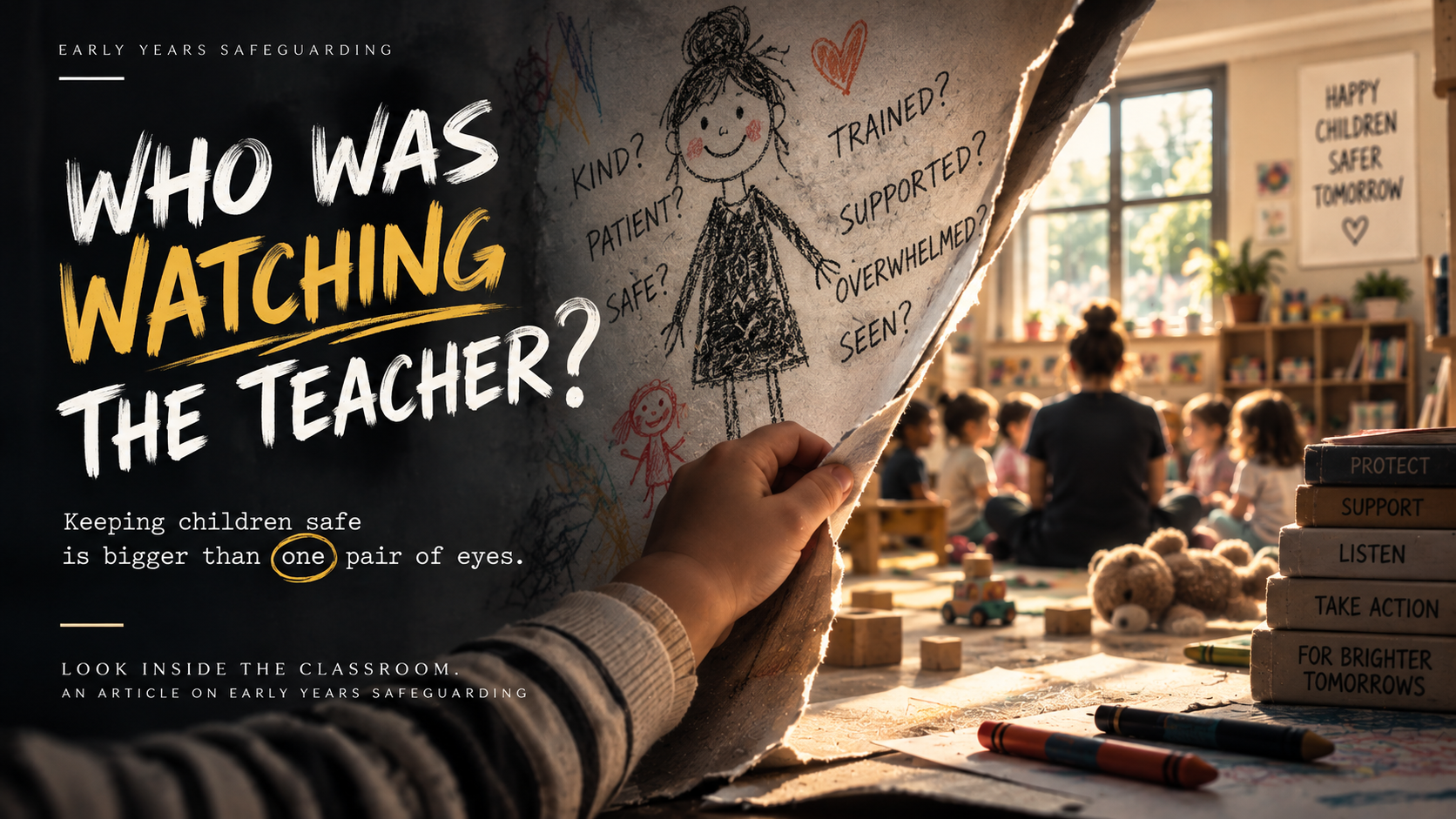
Before We Blame the Teacher, Look Inside the Classroom
What if the question we ask after a child gets hurt is the wrong one?
“Where was the teacher?”
It is an easy question to ask from outside the classroom. But what was happening in that room at that exact moment? What decisions was the teacher making, and what had already been decided long before the child walked through the door?
After years of working with young children, I have learned that some of the hardest truths about safeguarding sit in everything we do not see. And once you have actually stood inside that room, the story can look very different.
There is something remarkably easy about judging a classroom from outside. A child has fallen, so the teacher was not watching. A child has run, so the teacher was not supervising. A child has been hurt, so somebody must have failed. It sounds perfectly reasonable until you have actually been the person responsible for eighteen three-year-olds at the same time.
The recent Delhi case involving a three-year-old child at a playschool in Maujpur is deeply disturbing. According to police and media reports, the child was allegedly tied to a chair and physically assaulted over a period of time. An attendant was arrested and other school personnel were named in the case, while the school was subsequently sealed following reported safety and regulatory violations.
Let me be completely clear before going any further: an adult who deliberately hits, kicks, ties up or otherwise harms a child is responsible for that choice. I am not going to dress violence up as frustration, call it poor classroom management or look for a pedagogical explanation that makes it sound more acceptable. There isn’t one.
But there is another conversation sitting beside that one, and it is a conversation I think schools need to have much more honestly.
What does it actually mean to say that a teacher is responsible for a group of very young children?
Because responsibility and control are not the same thing.
I have been in classrooms where I was responsible for eighteen children and had to make decisions in seconds because there was no perfect option available. I remember one particular toilet situation. There were separate boys’ and girls’ toilets and one Didi available on the floor, but I could not know with certainty whether she was actually in the toilet at the moment a child needed help.
So I had choices, none of them particularly elegant. I could take all eighteen children to the toilet and then potentially have boys in the girls’ toilet or girls in the boys’ toilet, followed by the inevitable question about why I had done that. I could leave the children in the classroom while taking one child. I could send the child alone and hope the Didi was there. Or I could leave the group and go to check.
Whichever option I chose, I remained responsible for eighteen children.
And this is the part that is strangely absent from many conversations about safeguarding. We talk about responsibility as though it automatically comes with complete control over the environment. It doesn’t. A teacher can be responsible for a child without being able to predict every movement that child will make, every decision another child will make or every moment when another adult may be needed.
A safeguarding policy can tell you what should happen. It cannot tell a three-year-old to wait patiently while you solve the staffing problem.
International child-rights standards recognise that institutions caring for children have responsibilities relating to safety, competent supervision and the number and suitability of staff. It is not a particularly revolutionary idea when you have spent time with young children. If one adult is responsible for a large group and another adult is needed, the existence of a safeguarding policy does not magically produce that second adult.
I have attended safeguarding workshops. Many teachers have. We are told what to watch for, what to report, what appropriate conduct looks like and what our responsibilities are. All of that matters. But sometimes I wonder whether schools are very comfortable teaching teachers how to respond to impossible situations while being considerably less comfortable asking why the situation was impossible in the first place.
Then there is the question of who we actually put into these classrooms.
I often hear people say that schools employ uneducated women to work with young children. That is not what I have seen. Many people working in schools are educated. They may have degrees, qualifications in other fields, certificates, experience in international schools or a long list of professional-development courses.
And yet I have seen teachers with impressive qualifications, IB experience, seminars and certificates who simply did not have the temperament for early years.
The paper was there; the suitability was not.
This is where the word “resource” also bothers me. Schools sometimes talk about finding a resource, as though they are filling a timetable rather than choosing the adult who will spend several hours every day with two-, three- and four-year-olds. A child is not being handed to a spreadsheet. They are being handed to a person.
Early years needs knowledge, certainly. It also needs patience, emotional regulation, judgement and an understanding of what young children are actually capable of at different ages. A two-year-old shouting “mine” is not necessarily being defiant. A three-year-old refusing an instruction is not necessarily challenging your authority. Sometimes the child is simply three, and the adult is the one who is supposed to know the difference.
I remember a group of approximately four-year-olds working in small groups on a construction project using different materials. They were testing strength, figuring out what could support what and trying to make their ideas work. One child was good at building, another was fascinated by colours, another was useful at finding and passing materials, and another was still figuring out how to join the group. That is what early-years teaching actually looks like when it is working well: noticing what each child can contribute rather than expecting five children to behave like five identical little employees.
During that activity, two children had a disagreement. One pressed a block and it pressed into the other child’s skin, causing an injury. I dealt with it, as teachers do.
Could I have been more careful? Of course. There is always something to reflect on afterwards. But could I have predicted the exact second in which two children would disagree, the exact movement of the block and the exact position of the other child’s skin?
This is where we need to stop confusing risk reduction with the elimination of risk.
Children fall. They run. They snatch. They push. Fingers find doors. They climb things they have just been told not to climb. Sometimes something happens even when the teacher is right there. Their bodies are developing, their impulse control is developing and their understanding of danger is developing too.
That is childhood. It is not the same thing as an adult deliberately hurting a child.
I learned this even more clearly while working with mixed ages. A two-year-old and a four-year-old can learn beautifully together in some situations, but they do not have the same impulse control, independence, attention or understanding of danger. Mixed-age learning can work very well for certain parts of the day. That does not mean their needs suddenly become identical for the entire day.
On one occasion I was on the floor with children of different ages doing creative work and using safety scissors. One of the two-year-olds grabbed the scissors, refused to give them back and ran out of the classroom.
I had around ten other children on the floor.
So what exactly was I supposed to do?
Stay with the group and let a two-year-old run down the corridor carrying scissors, or leave the group and chase her?
I chased her.
She fell. Fortunately, nothing happened. But she could have fallen onto the scissors, poked herself in the eye or hurt another child.
There was also a senior adult present who watched what was happening rather than stepping in to help.
That has stayed with me, because there is a rather important difference between watching a teacher to support her and watching a teacher to catch her making a mistake. If a two-year-old is running out of a classroom with scissors, I would hope the first instinct of another adult would be to help stop the situation. We can discuss the teacher’s decisions afterwards. We can reflect, analyse and improve. But perhaps support should come before the post-mortem.
This is also why I find the question “Where was the teacher?” so frustrating when it is asked as though it settles everything.
Sometimes the teacher was right there, dealing with another child. Sometimes the teacher was making the best decision available between two imperfect options. Sometimes an accident happened in the two seconds between one child doing something and another child reacting.
And sometimes, yes, an adult has deliberately done something they should never have done.
Those situations cannot all be placed in the same box simply because a child was hurt.
Children are watching the adults making these decisions too, although they are not particularly interested in our safeguarding terminology.
Parents have told me that their children have remembered things I said years later: “Aneta Ma’am said not to interrupt when someone is talking.” “Aneta Ma’am said fasten your belt in the car.” “Aneta Ma’am says every action has consequences.”
You smile when you hear that, and then you realise just how much they were listening.
They watch how we speak when we are irritated, how we handle disagreement, what we do when somebody refuses to listen and what happens when we make a mistake. The teacher is not simply supervising the child; she is also showing the child what an adult looks like when things do not go according to plan.
That is why temperament matters so much in early years. A teacher will become tired and frustrated. Of course she will. We are human. The professional responsibility is knowing what to do with that frustration before it becomes something a child has to absorb: ask for another adult, step away when it is safe, take a breath, change the approach and come back to the situation.
A three-year-old does not need an adult who wins every battle. They need an adult who knows which battles belong to the adult.
Recent cases in India make this even more serious. In Visakhapatnam, six-year-old Pranay Teja collapsed at school after a teacher allegedly slapped him while reprimanding him over incomplete homework and later died. The teacher was arrested, and police altered the case to include culpable homicide not amounting to murder; the exact medical circumstances of the death remained subject to investigation and post-mortem findings. A slap from a teacher is not “just a slap”. It is an adult using physical power against a child.
The horrific incident at Ryan International School in Gurugram, where seven-year-old Pradyuman Thakur was killed in September 2017, raised another dimension of the same larger responsibility. He was found with a severe cut to his neck in the school toilet shortly after arriving at school. Subsequent investigations and proceedings raised serious questions about security and administrative failures at the school.
The person who commits a crime must answer for it. That does not prevent us from asking what the school could have done differently to protect the child. In fact, asking both questions is part of taking children’s safety seriously.
Parents have a role in this too. A genuinely unwell child should not be sent to school simply because arrangements at home are difficult. A school cannot become a substitute for medical or parental care. But parents should also be able to expect that when they leave their child at the school gate, the school has thought beyond the timetable: who is looking after these children, how many adults are available and what happens when one of them needs help?
Because that is the uncomfortable part.
We often talk about safeguarding as though it lives inside the teacher.
It doesn’t.
It lives in recruitment, staffing, supervision, management, training, the physical environment and the decisions made long before a teacher walks into a classroom. It also lives in whether the adults around that teacher notice when she needs help instead of waiting to see whether she will make a mistake.
None of this reduces the responsibility of a teacher who deliberately harms a child. It simply refuses to pretend that every incident involving a child can be understood by pointing at the nearest adult.
A three-year-old does not know who attended the safeguarding workshop. They do not know who wrote the policy, who approved the staffing or who made the recruitment decision.
They know the adult standing in front of them.
And perhaps that is where we should begin.



 English
  Polish