What this article is about
In early years classrooms, emotional conversations are growing louder while boundaries are growing quieter. Teachers are expected to absorb hitting, biting, and kicking — and smile gently through it. Parents are anxious. Schools are cautious. Somewhere in between, authority has become suspect. This reflection asks a difficult question: when did calm firmness become something we feel the need to apologise for?
Someone Has to Be in Charge
I have been thinking about this more than I intended to.
I began by reading reports — education surveys, mental health data, post-pandemic summaries — all written in careful, balanced language. They speak about emotional well-being, behaviour challenges, and rising stress in schools. All of this is true.
What those reports do not describe, however, is the sting of a bite on your arm while twenty three-year-olds are watching to see what happens next.
They do not describe being kicked in the shin and hearing yourself say, “It’s okay,” when it very clearly is not okay.
They do not describe the quiet expectation that a teacher must absorb physical aggression as though it were simply an occupational detail, like glitter in your shoes or paint on your sleeve.
Let us be honest.
Being kicked, scratched, bitten, or hit is not acceptable. It is not acceptable for a child, for a teacher, or for anyone.
And yet many educators will quietly admit that they are hesitant to react firmly. They are cautious. They are measured. They are careful not to appear harsh. Somewhere along the way, firmness began to look suspicious.
When did that happen?
In early years classrooms, we speak beautifully about feelings. We validate emotions. We regulate and co-regulate. We label emotional states with impressive fluency.
But when a child’s foot connects sharply with your knee, validation alone does not resolve the situation. Safety does.
And safety includes the adult.
There is a narrative circulating, polite and persistent, suggesting that the child must not be hurt, must not feel shamed, and must not experience distress. Of course that is true. No teacher wakes up hoping to harm a child. We are not villains in starched cardigans plotting emotional damage between snack time and story time.
We are mothers. We are women. We are caregivers. We are human.
We do not wish for little ones to be frightened. At the same time, we should not be expected to quietly endure harm in the name of gentleness.
If a child bites, it must stop.
If a child kicks, it must stop.
If a child throws objects at others, it must stop.
It must stop calmly, clearly, and immediately.
There is a difference between punishment and protection, and somewhere along the way those two ideas have become tangled.
I remember one particular afternoon when a child lost control completely. He was screaming, throwing blocks, and attempting to hit whoever was closest. There was no additional staff member available and no swift assistance coming. There was only me and a room full of very small observers absorbing every second.
I held him firmly from behind to prevent him from hurting himself or another child. He scratched my arms hard enough to leave marks. He pushed back into my face, and my muscles burned from the effort of holding steady.
At the same time, I was aware of the invisible audience that often exists now — the imagined complaint, the potential meeting, the careful explanation that might follow. Be gentle. Be cautious. Do not upset.
Meanwhile, twenty other children were learning something very important. They were learning whether the adult in the room could hold it.
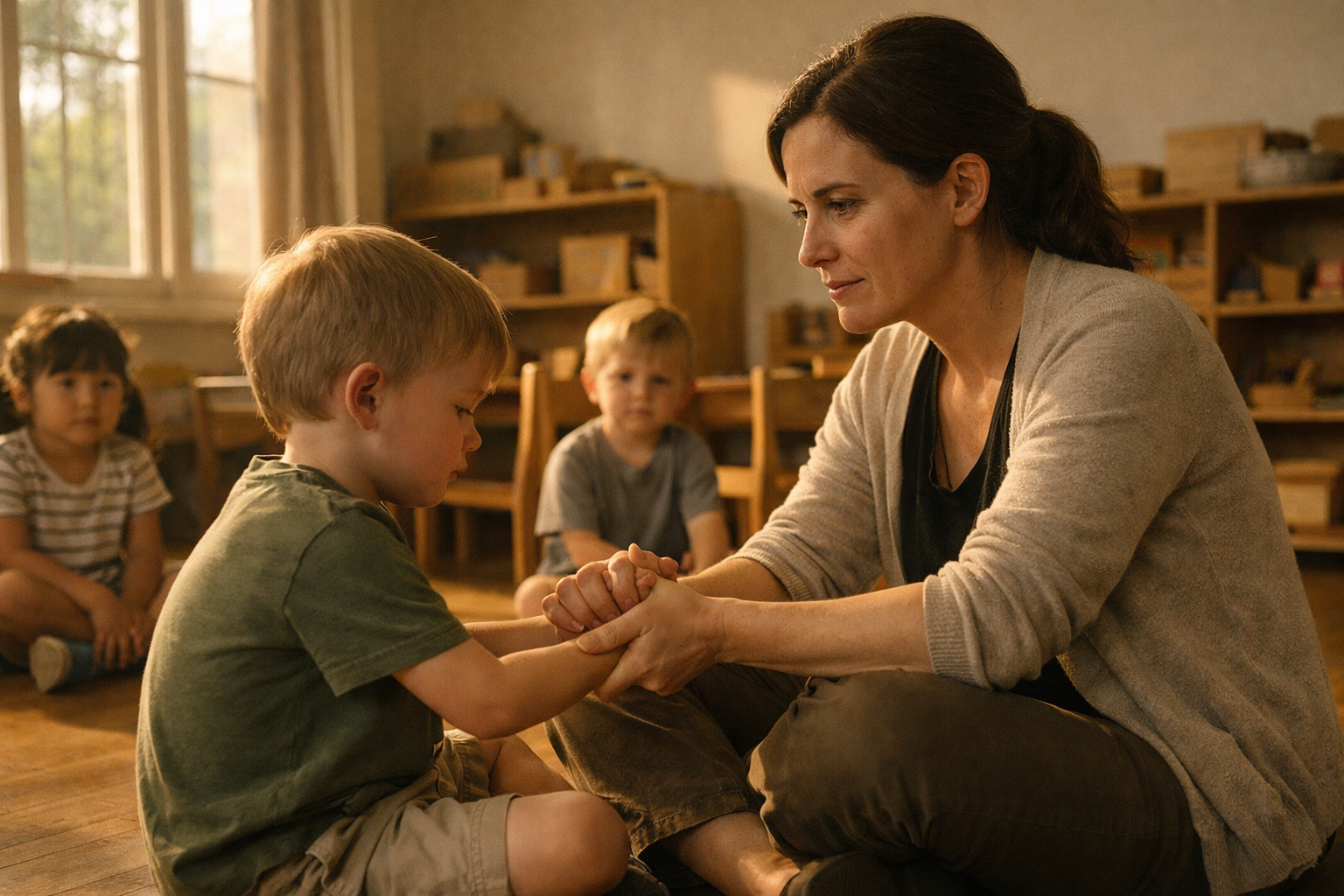
When I say, “This stops now,” in a calm and steady voice, it is not aggression. It is containment. It is a message to every child present that they are safe because someone is in control of the situation.
Here is the uncomfortable truth.
When a teacher absorbs aggression without response, the quiet children shrink. The anxious child becomes watchful. The sensitive child learns that chaos is tolerated. The child who is escalating learns that escalation works.
We talk often about protecting the child who explodes, but we speak less about protecting the children who endure the explosion.
And yes, we must also discuss parents.
Why are meetings about behaviour often reactive rather than proactive? Why is there hesitation to say, firmly and respectfully, “This cannot continue”? Why does it sometimes feel as though schools must persuade parents that boundaries are not cruelty?
Have we become so cautious about appearing strict that we avoid necessary conversations?
Parents are not enemies. They are tired, and they are navigating modern pressures that none of us were formally trained for. However, partnership requires honesty. Trust is not built by avoiding discomfort; it is built by clarity.
If a child is hurting staff or peers, the conversation must happen. It must happen not in accusation, but in alignment.
We all want the same outcome, which is safety.
And that includes the teacher.
Authority is not domination. Authority is the quiet decision to hold the room steady when emotions surge. It is removing the block that was thrown. It is stepping between two children. It is saying no and meaning it.
It can be done without shouting, without humiliation, and without apology.
Somewhere along the way, we began to treat firmness as though it were a relic from a harsher era, as though saying “enough” might permanently damage a child.
Children are far more resilient than our anxiety suggests. What destabilises them is inconsistency. What soothes them is clarity.
I have watched strong-willed children settle when boundaries are predictable. I have watched anxious children visibly relax when the adult in charge does not waver. I have also watched teachers quietly doubt themselves after doing exactly what was necessary.
That troubles me.
Because someone must be in charge.
Not to control. Not to intimidate. But to protect every single person in that room, including the adult.
Perhaps the real question is not whether children should be protected, because of course they should.
The real question is why protecting the teacher has become controversial.
Are we so afraid of appearing harsh that we forget teachers are human too?
I am still thinking about this.
Have we confused kindness with permissiveness? Have we mistaken steadiness for severity? Is there a way to speak more openly about teacher safety without being accused of lacking compassion?
I do not claim to have the final word.
I only know this.
When an adult is calm and firm, most children exhale.
And perhaps, in all our careful conversations about emotional safety, we must remember that safety belongs to everyone in the room.
I would truly like to hear your thoughts.
Have I overlooked something?
Or is it time we admit, gently but clearly, that someone must hold the door when the wind begins to push against it?



 English
  Polish