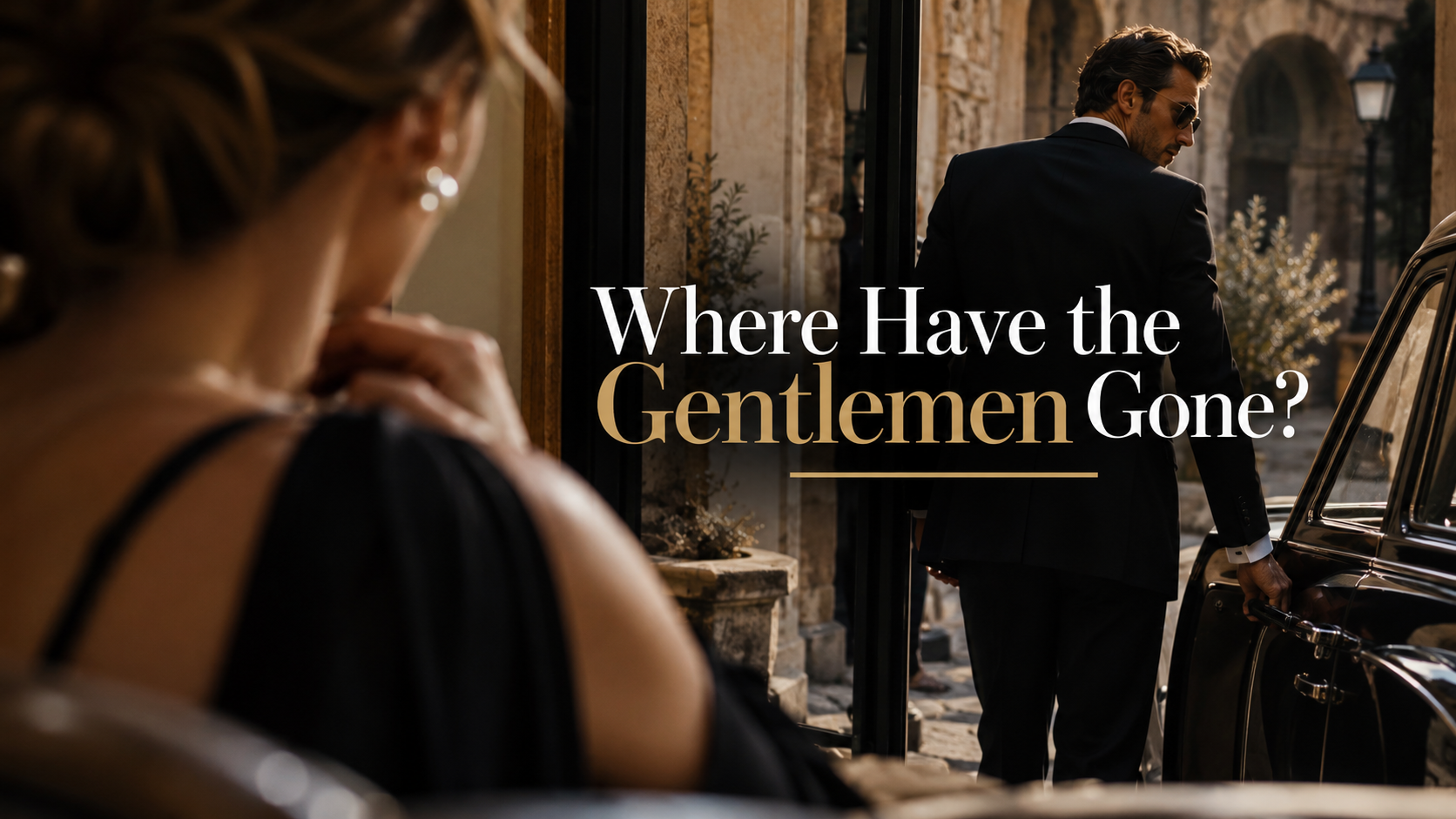
where have THE gentelmen Gone? men , women and the modern manners.
The shoulders are broader, the opinions louder, and everyone seems determined to prove they need nobody. Yet some old-fashioned qualities remain strangely attractive. A little courage. A little character. The ability to open a door without expecting the world in return. Whatever happened to those?
A friend recently sent me an article by Gloria Steinem. It set me thinking about men and women, and about the curious business of progress: how we can spend decades correcting one mistake, only to discover that we have developed several new ones along the way.
Steinem was right to challenge a world that expected women to be grateful for the little freedom they were allowed. Women should be able to earn their own money, make their own decisions, build careers and leave relationships that make them unhappy. We should not need a man’s permission to live our lives. That much ought to be settled by now, although humanity has an extraordinary talent for reopening questions that should have been filed away generations ago.
What interests me is what happened to the conversation about men while we were busy putting women back in charge of their own lives. We have become very good at explaining what women do not need from men. I am less convinced that we have been equally successful at explaining what makes a man worth having around.
I still have a soft spot for the old-fashioned idea of a gentleman. Not the theatrical variety who opens a door with one hand while expecting lifelong gratitude with the other, but the man who possesses something less visible than a tailored jacket: character. I grew up with films and stories about men who stood their ground, kept their word and understood that courage meant more than looking impressive in a photograph. Vikings, soldiers, men returning from wars, men who would put themselves between danger and the people they loved. Cinema was generous with the heroism and rather economical with the ironing, but the underlying idea stayed with me.
Strength was supposed to be useful.
Today, strength has acquired a much more photogenic career. There are men whose shoulders could accommodate a small family, whose protein intake is planned with the precision of a military operation, and whose bathroom mirrors have probably heard more declarations of devotion than their partners. Nothing wrong with looking after yourself. But a beautifully constructed body is still only a body. It cannot take responsibility for you, keep a promise for you or tell the truth when the truth might cost you something.
A man can lift a weight that would defeat an ordinary wardrobe and still find an honest conversation unbearably heavy. He can look formidable in the gym and disappear at the first sign of emotional difficulty. The muscles are real; the courage remains under review.
I am old-fashioned? maybe, but I still find something irresistible about a woman whose elegance makes femininity look effortless, and a man in a beautifully cut suit who carries himself with the quiet authority of James Bond. Clothes do not create character, of course, but they can reveal an appreciation for detail, discipline and the way one presents oneself to the world. There was a time when elegance could turn heads and composure could command respect. Apparently, both now need a rebranding.
Women have changed too, and rightly so. We no longer have to pretend that helplessness is feminine or that a woman becomes more desirable as her ambitions become less visible. We can work, travel, earn, decide and manage our lives. We can also open our own jars, carry our own suitcases and assemble furniture without waiting for a man to arrive and discover that the instructions are written in a language he has never encountered.
But must independence become a full-time performance? Must we demonstrate, at every opportunity, that we need absolutely nothing from anyone? I can pay my bills and still appreciate a man who notices that I am tired. I can make my own decisions and still enjoy someone taking the initiative. I can defend myself and still find it attractive when a man makes me feel safe. There is no contradiction here unless we have decided that being independent means turning every ordinary human pleasure into a political statement.
I do not want a man to run my life. I would, however, like him to bring something to it besides his laundry.
And then there is the gentleman, a figure who seems to have become suspiciously controversial. Some hear the word and imagine a patriarch in polished shoes, holding a door open while calculating how much obedience the gesture has purchased. Others treat courtesy as if it were an embarrassing hobby inherited from an elderly aunt. Between these two extremes, a perfectly decent man is left wondering whether offering his coat is charming, oppressive or simply a logistical mistake.
For the record, I still want to see a gentleman who knows how to treat a woman respectfully even when she is being spiteful, raising her voice or throwing insults around. His manners should not depend on her being sweet, agreeable or sufficiently grateful for his existence. He can disagree with her, tell her she is out of order and walk away without turning himself into an equally unpleasant spectacle. That is not weakness. It is self-command, a quality that seems to be in shorter supply than opinions.
Women are not exempt from the rules of civilisation simply because previous generations were unfair to them. A woman who humiliates a man in public, barks at a stranger or assumes that her anger entitles her to treat another person with contempt is not displaying power. She is displaying bad manners with an inflated sense of importance. We cannot demand respect for women while treating men as convenient targets. Equality was supposed to expand our freedom, not provide us with a larger audience for our worst behaviour.
I know what it is like when people seem to assume that, because I am Polish and direct, I will accept a tone they might hesitate to use with someone else. Apparently, directness is a curious national service: it allows other people to say whatever they please and then congratulate themselves for being honest. If I object, I risk being told that I am direct myself, as though this somehow settles the matter.
It does not. Being able to take an insult does not mean I have volunteered to collect them. My nationality is not permission to lower the standard of how I am treated, and honesty does not require a person to abandon basic courtesy. There is a difference between speaking plainly and speaking as though the other person has been put on earth to absorb your moods.
I have no interest in restoring the old arrangement in which a woman was expected to obey and a man was automatically considered respectable because he occupied the head of the table. A door held open is a lovely gesture. It is not a character reference. Neither is a deep voice, a large salary, a confident handshake or a photograph of oneself looking stern beside an expensive car.
What matters is what happens when a man is contradicted, inconvenienced or provoked. Does he retain his dignity? Can he be firm without becoming cruel? Can he care for someone without needing to control them? And can he treat a woman with respect without requiring her to perform femininity to his satisfaction first?
The same questions belong to women. Can we disagree without humiliating? Can we be strong without making someone else feel small? Can we recognise a good man without immediately suspecting that his kindness must conceal an invoice?
I believe in women, and I believe in men. I do not believe that one sex must be diminished for the other to flourish. Nor do I believe that women fought for freedom so that we could all become equally rude, equally self-absorbed and equally incapable of offering one another a little grace.
Maybe we have mistaken the removal of old rules for the removal of all standards. The first was necessary. The second is hardly an achievement.
I would still choose the man who can remain courteous when provoked, who keeps his word when nobody is checking, who is brave without needing to advertise it and who understands that protecting someone does not mean possessing them. I would choose him over the man who can recite all the right opinions but cannot manage his temper, his ego or his responsibilities.
And I would hope he would choose a woman who knows the difference between independence and contempt, who can stand on her own feet without demanding that everyone else kneel.
We fought for equality, not for the privilege of being disappointed in each other on equal terms.


 English
 Polish
