This piece reflects on teacher spirit in early years — the quiet force that keeps teachers connected to children even when the work becomes heavy, uncertain, and difficult to stay in. It sits with memory, doubt, and the moments that make teaching feel alive despite everything else.
I’ve written before about the tragedy of teacher life — the absurdities, the exhaustion, the emotional labour that accumulates quietly and then all at once. That story already exists. I don’t need to reopen it today.
This piece sits somewhere else.
It sits with teacher spirit in the early years. With the question of what keeps it alive even when everything around it feels heavy, rigid, and unresponsive.
What I’m holding now is a different question.
It arrived without warning, without drama, without a clear shape: if it is really this hard, why am I still drawn to children? Why does that part of the work refuse to loosen its grip?
I’m not standing on solid ground as I write this. I’m standing in between. Between leaving and returning. Between knowing exactly why I stepped away and still feeling something tighten when I think of a classroom.
There are unanswered messages. Closed doors. Enough experience to be tired of pretending. Enough silence to understand what it means. And still — the pull doesn’t disappear.
Some memories don’t fade when you leave a place. They wait. They surface when you least expect them. Not as nostalgia, but as reminders of something that once made sense in your body before it was explained away by adults.
While going through old drafts, I found a fragment I had written years ago. Reading it now, I realised it holds the part I can’t explain in any other way.
So I’m sharing it.
I remember this day very clearly.
I was angry before I even entered the classroom. One of those sharp pieces of information had reached me at the entrance — the kind that doesn’t explode, but settles heavy in your chest. I walked in carrying that weight.
The classroom was cold. Empty. Still.
I opened my bag. Laptop out. A box of peanuts I’d grabbed on the way, planning to munch absent-mindedly. Coffee in my hand. I was just about to sit down and take the first sip.
And then—
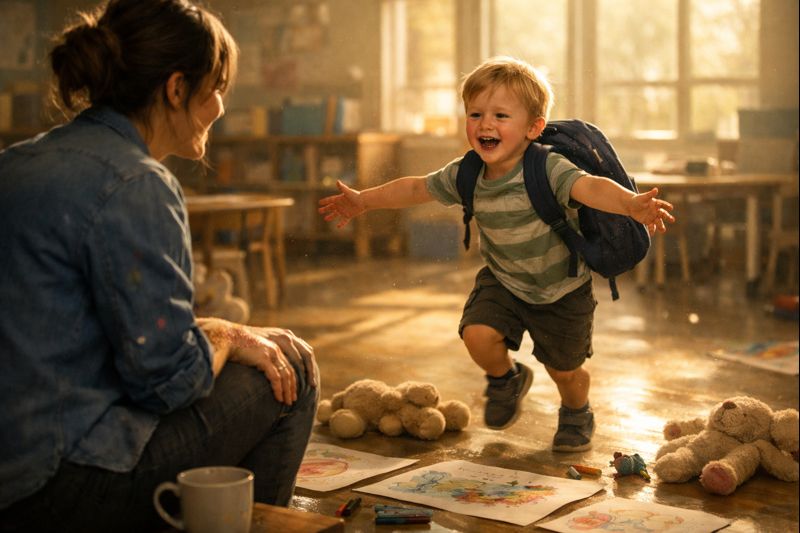
I saw a small heart running toward me.
A heavy backpack on a tiny body.
A big smile.
“Ma’am… Ma’am…”
Arms reaching for a hug. Not for comfort. Not for reassurance. Just because.
I forgot everything.
That smile — that hug — was exactly what I didn’t know I needed. The weight lifted without effort. The day shifted.
We sat together for circle time. We talked, sang, danced. We decided — together — what the day would hold. The children chose painting, stories, and play.
So we began.
Paint went everywhere. On paper. On hands. On clothes. The classroom filled with laughter, colour, and deep focus. I couldn’t sit. I had to be part of it.
There was a P.E. class scheduled.
We forgot about it completely.
The children decided, “No, no P.E. today.”
“Okay,” I said.
I knew what that decision would cost me later. I knew the conversations that would follow. But learning was alive. And for once, I wasn’t holding my breath or talking myself down between moments.
We cleaned up later, of course. The children were enthusiastic — they always are. We all know how that ends. The helper eventually helped us properly, and we stepped outside to catch the wind.
The letter W.
Arms stretched wide, we flew like planes. We searched for wind — in the grass, behind trees, between buildings. The children found the strongest current in the narrow space where air rushed freely.
Later, tired and satisfied, we returned to the classroom. Water break. We watched whales. We learned how to whistle. All with W. And more.
I felt a small headache coming on and asked for a moment of quiet. “Let’s play a whisper game,” I said. “Whoever whispers the longest wins.”
Silence arrived in small pockets.
Then Myra said, “Whisper is W.”
“Yes!” I said, loudly.
“Ma’am… whisper,” the children corrected me.
How do you not love them?
I think I managed maybe thirty seconds of silence. That’s winter in early years.
Reading time turned into storytelling. Everyone added something. The story shifted, bent, became something else entirely.
The wolf — angry and hungry — became their friend. They made bubbles with straws from the hut and jumped into a boiling pot, which apparently was only hot for bathing. Because it’s a story. And no one gets hurt.
The day with the children was good.
Later, I had to listen.
Why cancelling class without prior notice was wrong.
Why taking children outside needed permission.
Why it should have been written in the planner.
Why this. Why that.
I listened.
And I felt sad — not defensive, not rebellious — just sad that so many people don’t understand how learning actually happens. All the theory. All the planning. And still missing the moment.
Why should I stop when learning is alive?
Why can’t learning be joyful?
Why can’t we step outside when the moment asks for it?
Why can’t I teach the way children are inviting me to?
Why can’t I paint, laugh, play, get dirty — and let that be enough?
By the end of the day, I was exhausted.
And also full.
If not for these small humans — the ones who run toward you for no reason, who remind you to whisper, who turn wolves into friends — I would never stay in these spaces.
It’s too much otherwise.
They keep me healthy.
They make me smile.
They make me want to be there.
Today was a good day.
But I don’t know how much longer I can carry the weight of grown-up rules around it.
And that’s where the meaning sits.
Schools don’t function on policies alone. They function because teachers carry light into spaces that would otherwise feel cold, rushed, and rigid. Teachers soften edges so children can grow. They translate pressure into safety. Complexity into play. Expectations into possibility.
Whether institutions acknowledge this or not doesn’t change the truth. They are where they are because teachers keep showing up and making something human out of something mechanical.
This is not romance.
It is observation.
Teacher spirit isn’t loud. It doesn’t argue for its worth. It doesn’t demand applause. It simply keeps learning alive — often quietly, often at personal cost, often without permission.
I don’t yet know where I stand. Whether I return fully, remain at the edge, or move somewhere else entirely. But I know this: the part shaped by children doesn’t disappear.
It listens differently.
It notices differently.
It remembers what learning feels like when it is real.
That light matters.
And for now, naming it is enough.


 English
  Polish