Teachers and Administrators Collaboration
A Personal Reflection
This isn’t a judgment or a final truth. It’s an observation I felt compelled to name.
When Education Turns Quiet: A Reflection on Teachers, Administrators, and Trust
In this reflection, I look at the quiet tensions that shape educational systems—how creativity, control, silence, and responsibility interact over time, and what changes when collaboration slowly gives way to distance.
The thought didn’t arrive all at once. It surfaced gradually, during quiet moments of reflection, when familiar patterns start to repeat themselves a little too clearly to ignore. Writing about it became less of a choice and more of a way to understand what I was seeing. Sometimes a small moment—a sentence, a pause, a routine exchange—opens the door to a much larger story. This piece is simply my way of standing in that doorway for a moment, and inviting others to pause there too.
The Playground of Education: Castles or Battles?
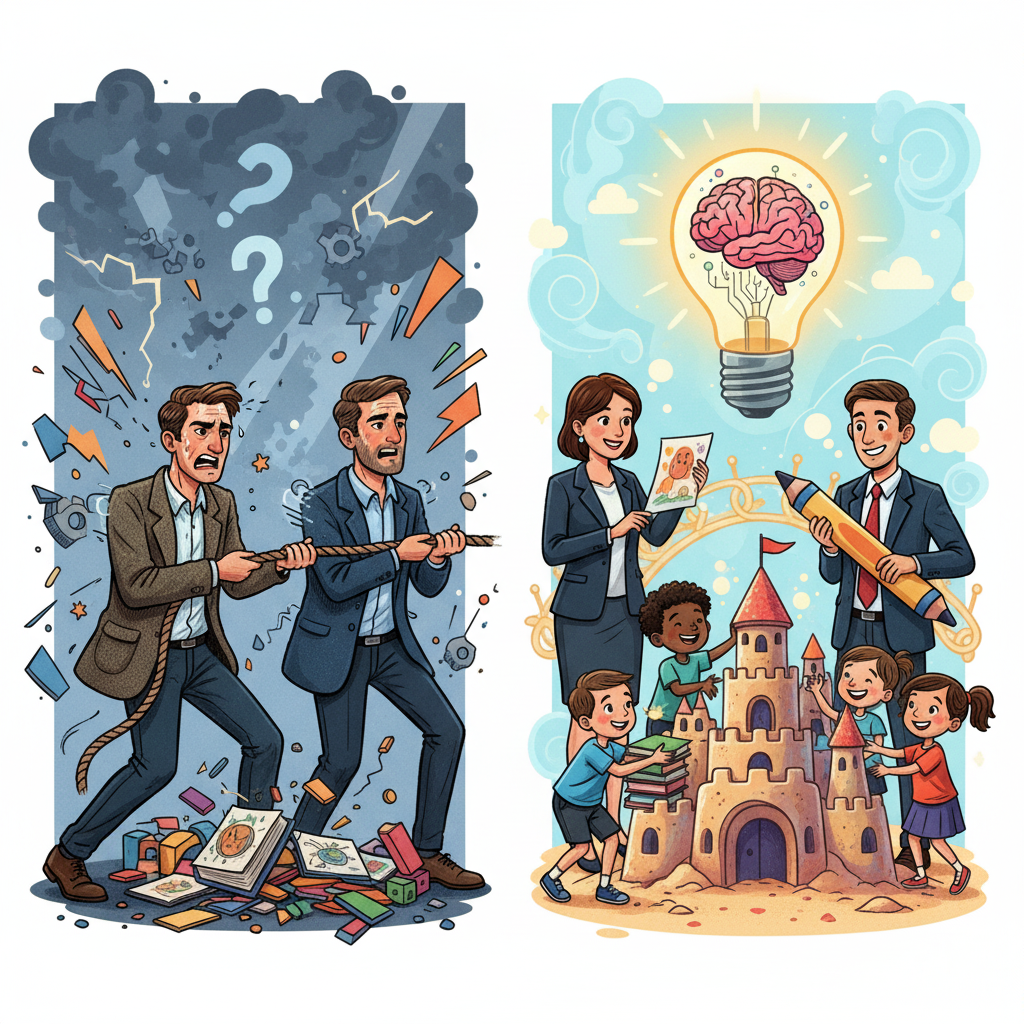
Education often feels like a playground. Teachers are the ones building sandcastles—shaping lessons with imagination, care, and trial-and-error. Administrators are the ones setting the boundaries of the sandbox, making sure the structure holds and no one gets hurt. Both roles matter. But when trust thins and collaboration fades, the playground changes. Castles collapse more often than they’re built, and what should feel shared begins to feel contested.
The question isn’t who matters more. It’s how a space meant for learning turns into one filled with quiet tension—and what gets lost when that happens.
When Micromanagement Feels Like Chains on Creativity
There’s a particular feeling that comes with being told exactly how to stack your blocks or which colors are acceptable. In classrooms, that feeling shows up as micromanagement. What begins as guidance slowly tightens into control. The room grows quieter. Risk disappears. Creativity becomes something to manage rather than encourage. Over time, teaching starts to resemble compliance more than curiosity.
The Mechanism Beneath the Surface
Over time, something subtle happens in systems like this. Responsibility drifts toward the people closest to the work, while decision-making slowly moves upward. What begins as support becomes oversight, and what begins as flexibility becomes control. No one announces the shift. It simply settles in. And in that space—between expectation and authority—silence starts to feel safer than honesty.
Feedback Fears: Spilled Paint and Silent Voices
Asking for honest feedback without safety is like asking who spilled the paint while already holding the brush. The response is predictable. Silence. Careful words. Agreement without conviction. Environments shaped by fear don’t lack opinions—they lack trust. Ideas stay contained. Conversations lose depth. Speaking becomes riskier than staying quiet.
The Invisible Weight of Overtime
Teaching rarely ends with the final bell. It stretches into evenings, weekends, and restless thoughts. Lessons are refined at kitchen tables. Papers follow people home. Ideas surface at inconvenient hours. This invisible labor often goes unnamed, and when it does, it’s frequently framed as passion rather than work. Over time, that distinction takes a toll.
When Development Doesn’t Develop
Professional development often arrives with energy and intention. Slides are shared. Notes are taken. But without continuity, the momentum fades quickly. By the time routine settles back in, very little has changed. Learning without support becomes another obligation rather than an opportunity.
Two Halves of the Same Whole
Teachers bring lived experience, adaptability, and a deep understanding of classroom realities. Administrators bring structure, resources, and long-term vision. Each role sees something the other cannot. Problems emerge not because one side lacks value, but because the connection between them weakens. What should feel complementary begins to feel misaligned.
Why This Tension Matters
Teachers and administrators are not opposing forces. They’re teammates working on different parts of the same field. One handles the immediacy of human interaction; the other manages the systems that support it. When trust erodes, the cost isn’t just professional—it’s personal. And eventually, it reaches students.
Final Thought: Building Without Breaking
Education isn’t only about what children learn. It’s also about how adults learn to work together. We can spend our energy dismantling each other’s efforts, or we can build something stronger alongside one another.
The playground hasn’t disappeared.
But what we choose to do inside it matters.


 English
  Polish