When Kids Wear Courage Like a Snack and Adults Treat It Like a Complicated Ritual
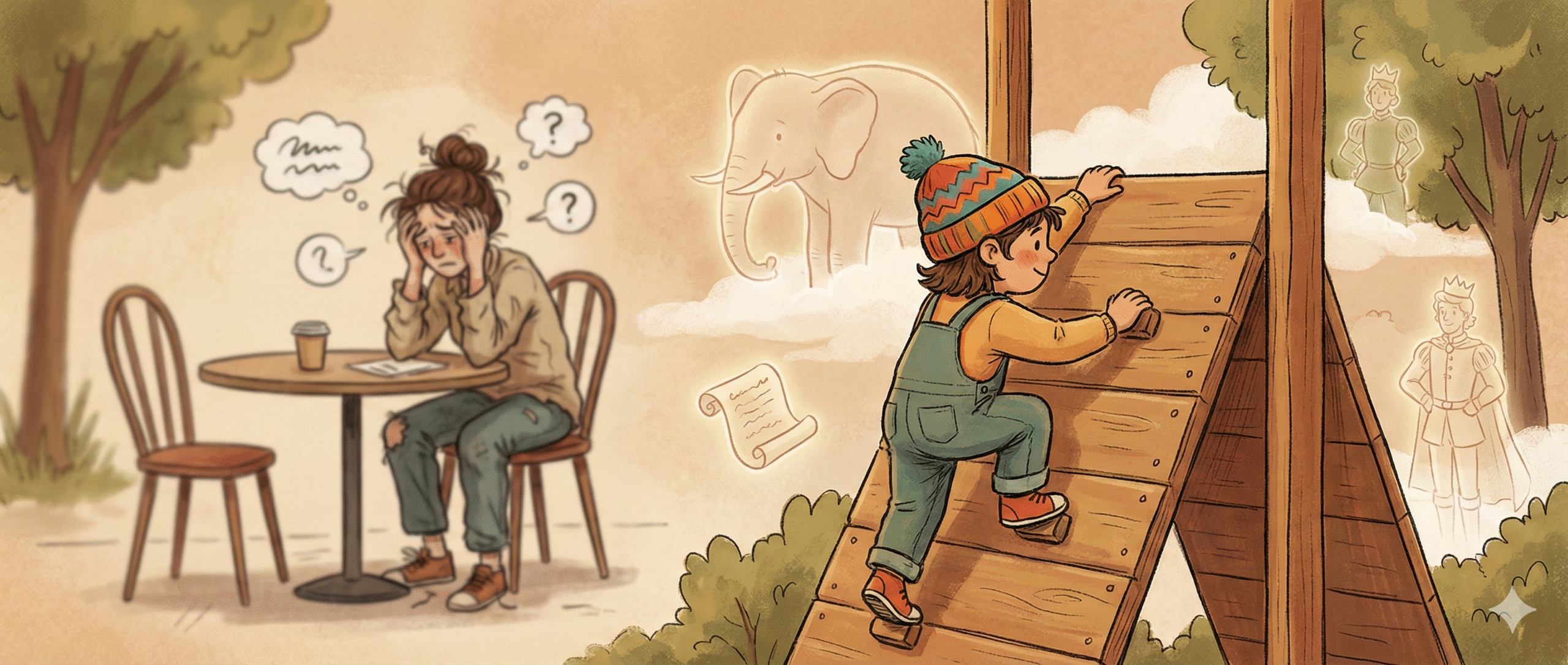
Sometimes I wonder if courage doesn’t actually live in adults at all, but hides inside children and only occasionally lets us borrow it like a sweater that doesn’t quite fit anymore. Kids treat courage like it’s a playground snack — they pass it around, drop it, pick it up again, share it, forget it exists, and then suddenly do something terrifying with zero warning. Meanwhile adults need a motivational podcast, two coffees, a deep breath, and a full moon ritual before we decide to “be brave.” It’s funny because the old Chaddanta Jataka — the tale of an elephant king who keeps his dignity through pain instead of drama — basically warned us that real courage is not fireworks but endurance. Children figured this out without even knowing they’re quoting ancient wisdom with their messy actions.
The Climbing Wall and the Child Already Practicing Ancient Courage
Take that little girl and the climbing wall. Three days of her throwing herself at it like she had a personal contract with gravity. First she climbs a bit, freezes, announces she’s scared like I hadn’t already noticed, slides down, gets dramatic, cries like someone stole her future, and then — magically — tries again. Every single time I asked if she wanted help, she acted like I had offered her a humiliating discount. And then of course the day comes where she doesn’t just climb — she conquers. Climbs straight to the top before I can say “Wait.” Then looks at me with the seriousness of a tiny gladiator and says, “I’m jumping.” And jumps. The happiness on her face could recharge a dying sun. After landing she acted like she had invented courage herself, then kindly began teaching her friends how not to die on the wall. The way she fell, cried, tried again, and climbed anyway was the living version of the Chaddanta Jataka’s endurance courage — except with more screaming and fewer moral speeches.
Truth Courage: Kids Deliver It in One Sentence While Adults Need Manuals
And then there’s truth courage — the one adults treat like it requires a legal disclaimer. When that girl told the boy about the date, she did it with such clean honesty I wanted to applaud. She tried, she showed up, she gave the day a chance, and found absolutely nothing romantic in it. Instead of creating a complicated diplomatic speech, she simply told him she felt no connection. She wasn’t ready to date. She wanted to focus on her goals. Adults would still be writing a message: “It’s not you, it’s me, but also maybe you a little, but mostly the universe.” Meanwhile she delivered a clear, respectful “no” without guilt. It was the modern echo of the Sacca Jataka, the tale about telling the truth even when it’s uncomfortable — except hers was shorter, cleaner, and with more backbone than most adults manage.
Speaking Through Whispers: The Courage of Continuing to Be Yourself
My favourite version of courage, though, is the one that walks quietly into everyday humiliation, sits next to you, and says, “Well, here we are again.” That was me with my accent. Polish roots mixed with Indian-English seasoning — a combination that confused half the room and delighted the gossip department. I heard the whispers. I saw the smirks. I pretended not to notice, because if I reacted every time someone had an opinion, I’d need medical supervision. I kept talking because my job needed my voice, not their approval. And then one principal — the kind that actually deserves the title — looked around and said calmly that mocking someone’s accent reveals more about the mocker than the speaker. The silence that followed was a tiny masterpiece. It reminded me instantly of the Mahāsutasoma Jataka, the tale of a prince who refuses to abandon his principles even when threatened — because continuing to speak with my accent felt exactly like that: a stubborn, quiet “I’m not shrinking for you.”
Workplace Courage: The Circus Where Adults Forget How to Behave
Of course, workplaces provide their own circus of courage lessons. I once told a colleague, politely I might add, that forcing four-year-olds to write perfect lines is not developmentally correct. She didn’t appreciate my honesty and told me to shut up, which was charming. Then gossip broke out, someone else jumped into the middle of our discussion like they were auditioning for a drama series, and the next thing I knew, she ran to the principal crying like I had attacked her livelihood. I was called in, accused of being rude, accused of taking the principal “for granted,” whatever that was supposed to mean. There’s something almost comical about moments like that — children fall and get up; adults fall into gossip holes and drag everyone with them. Standing there and not turning into a volcano felt very much like Chaddanta’s calm under pressure — the same tale where dignity survives nonsense, except the nonsense in my case had better Wi-Fi.
The Most Difficult Courage: Admitting We Were Wrong
And then comes the courage adults avoid most: admitting we were wrong. I judged a colleague without knowing anything, assuming she didn’t care. We all judged. We all whispered. Then one day we actually sat down. She told me about the back pain, the exhaustion, the days she literally couldn’t get out of bed after carrying children all afternoon. Her salary was cut. She was struggling. She wasn’t lazy — she was suffering. My judgment shrank to the size of a peanut. So I apologized properly: “I judged you unfairly. I’m really sorry.” No excuses. No “I didn’t mean to.” Just a human admitting they were wrong. She accepted it with tired grace. That moment hit me like the Sacca Jataka’s truth lesson — the part where courage isn’t loud honesty toward others, but painful honesty toward yourself.
What Courage Really Looks Like When Nobody Is Pretending
And that’s really what I wanted to write down today: courage is not what we were told it is. It’s not heroic, dramatic, cinematic. Courage is messy. Courage is quiet. Courage is saying “no” when everyone wants you to say “yes.” Courage is climbing again after crying your lungs out. Courage is speaking with an accent while people whisper. Courage is standing alone in a room full of politics. Courage is looking someone in the eye and saying “I’m sorry, I was wrong.” Courage is truth said kindly. Courage is fear carried honestly. Courage is failing and trying anyway. Courage is deeply, painfully, beautifully human — a mix of modern chaos and ancient wisdom replaying itself in classrooms, staff rooms, phone calls, and stupid meetings.
And children — those tiny fearless philosophers — do it every day without even realising they’re teaching us how to live.



 English
  Polish