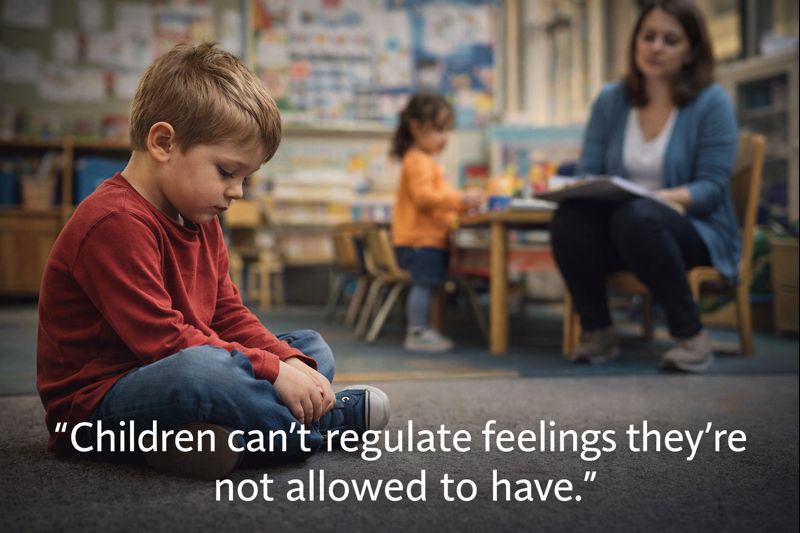
This article explores how children learn to regulate their emotions when they are given space to feel, rather than being rushed, corrected, or calmed too quickly.
Self-regulation has become one of the most praised skills in childhood. We talk about it in classrooms, parenting workshops, policies, and training manuals. Children are expected to calm themselves, manage emotions, wait patiently, and cope quietly. On paper, it sounds reasonable. Necessary, even.
But in real classrooms, something feels off.
Because while we teach children to regulate, we often remove the very conditions that make regulation possible.
Self-regulation does not begin with control. It begins with feeling. With expression. With an adult who can stay present when emotions are big, messy, and inconvenient. Yet many learning environments now demand regulation without allowing emotion first. Children are asked to calm down without being allowed to be upset. To breathe deeply without being angry. To use strategies without having space to experience what those strategies are meant to support.
I see this most clearly when children are praised for managing themselves but rarely met in their emotions. A child is upset and is quickly reminded to take deep breaths. Another is frustrated and redirected to a task. Another is overwhelmed and praised for “holding it together.” The intention is good. The message, over time, is not.
The message becomes: feel less.
Children learn very early which emotions are acceptable and which are not. They learn how much space they are allowed to take up. They learn that regulation is rewarded when it is quiet, quick, and invisible. Over time, many stop expressing altogether. Not because they are regulated — but because they have learned that expression costs connection.
Self-regulation without relationship turns into self-silencing.
True regulation is not something children do alone. It develops through co-regulation — through adults who stay close during emotional storms, who name what is happening, who don’t rush to fix or distract, and who can tolerate discomfort without needing the child to stop feeling. When that support is missing, children still adapt. They always do. But the adaptation often looks like shrinking.
I remember a child who was constantly praised for “using his strategies.” He was quick to sit, breathe, and comply when upset. He never raised his voice. He never cried. One day, after a difficult moment, I asked him how he felt. He paused and said quietly, “I don’t know. I just make it go away.”
That is not emotional literacy. That is emotional erasure.
We live in systems that value smoothness. Predictability. Flow. Children are expected to fit into environments that move fast and leave little room for disruption. Regulation becomes a requirement rather than a process. And when children struggle, the focus often shifts to teaching better techniques instead of questioning whether the environment is asking too much.
Self-regulation is not the absence of emotion. It is the ability to move through emotion with safety, support, and recovery. It includes anger, resistance, grief, excitement, and joy. When we skip over these experiences in the name of regulation, we do not prepare children for life. We prepare them for compliance.
When resilience is treated as something children must carry alone, we misunderstand how it forms. I explored this responsibility more fully in Raising Resilient Children Is an Adult Responsibility, Not a Child’s Burden.
Children need space to feel before they can learn to regulate. Space that is not rushed. Not optimised. Not managed away. They need adults who can sit with intensity without trying to shrink it. Adults who understand that dysregulation is not failure, but communication.
When we give children room to feel, regulation develops naturally over time. It grows from safety, not pressure. From relationship, not technique.
If we want emotionally healthy children, we have to stop asking them to regulate emotions they are not allowed to have.



 English
  Polish