What happens when Polish sayings are translated into English? Apparently, a nation full of people discussing sugar in the rain, warning children about wolves and witches, and expressing entire emotions with a single swear word. Welcome to the wonderfully confusing logic of Poland.
Lately, Instagram has been doing its very best to explain Polish people to the rest of the world. My feed is full of reels listing our habits, our strange behaviors and the things that supposedly make us uniquely Polish. Some are wildly exaggerated. Some are completely wrong. Many are suspiciously accurate. Every now and then one appears that makes me stop scrolling and wonder whether I somehow missed an important part of my own culture while busy being Polish. Apparently, we are direct. We complain constantly. We walk everywhere. We survive winters that would convince other nations to abandon civilization altogether. We think food solves most problems and tea solves the rest. None of this particularly surprised me. What surprised me was realising that the most entertaining thing about Poland rarely appears in these videos at all.
It is the way we speak.
I do not mean the language itself. I mean the expressions, warnings, threats, observations and pieces of life advice that Poles use every day without giving them a second thought. The kind of phrases that sound perfectly reasonable to us but, once translated into English, make us sound like a nation that should perhaps be observed from a safe distance.
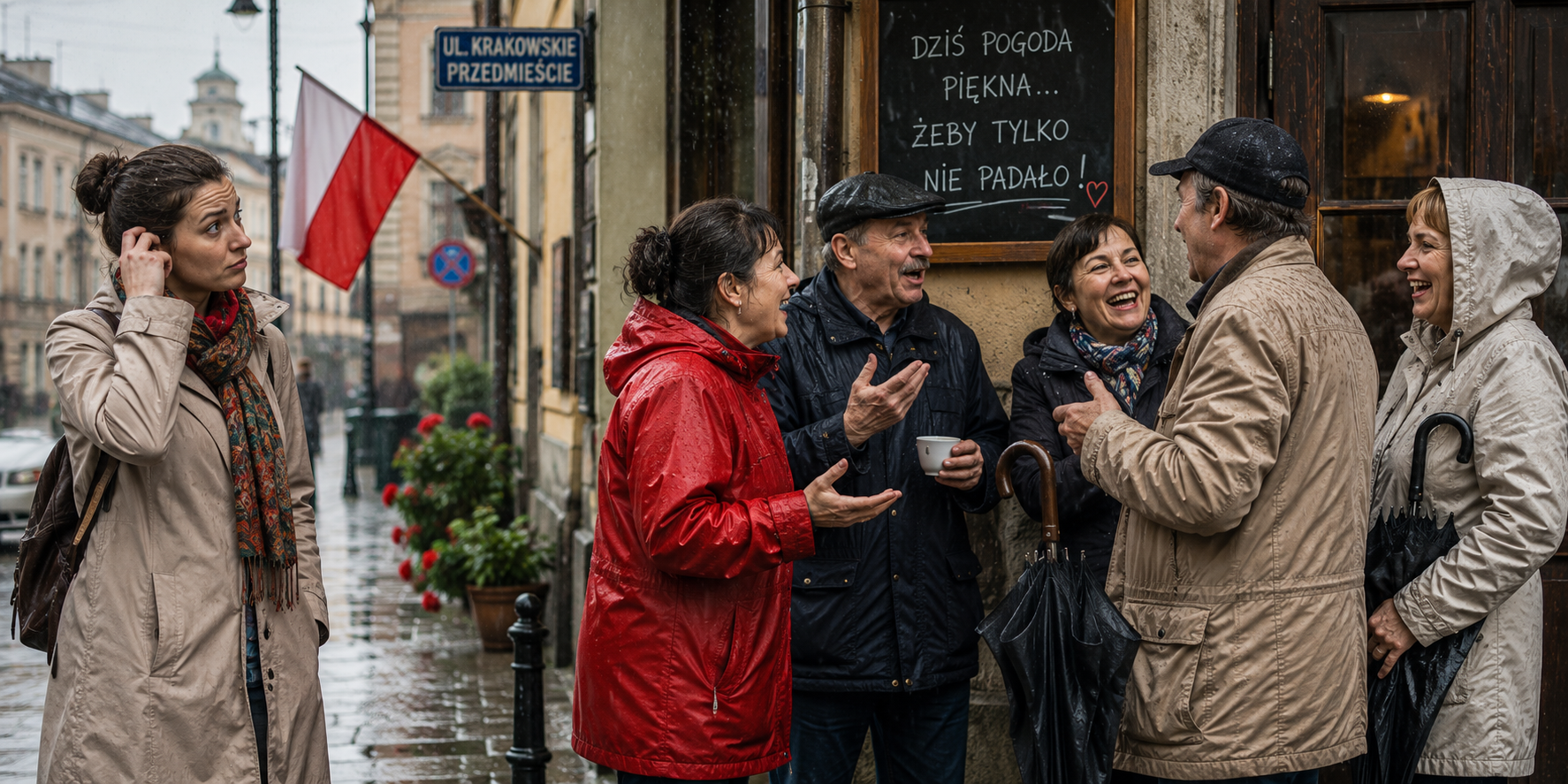
Take the weather. Foreigners often claim that Poles complain constantly, and their favorite evidence is usually rain, snow, wind, cold, heat, fog, drizzle and anything else the sky decides to produce. This is not entirely accurate. Complaining suggests a desire for circumstances to improve. Most Poles have already accepted that the weather is terrible and intend to continue with their plans regardless. Poland sees rain and immediately begins discussing sugar. “Nie jesteś z cukru” means “You are not made of sugar,” usually followed by “Nie roztopisz się” or “You won’t melt.” Nobody finds this unusual. Entire generations have heard these phrases and thought, “Fair point.” Only when translated does one begin wondering why Polish people spend so much time discussing the possibility of turning into confectionery.
The truth is that Poles do not complain about the weather as much as they narrate it. Two Poles can stand outside discussing how dreadful the rain is, how the wind has personally insulted them and how the temperature appears to have given up on civilization altogether, only to remain standing in exactly the same place for another fifteen minutes after saying goodbye. At some point one must conclude that the weather was never the problem. The weather discussion itself is the activity. The weather exists, we acknowledge its presence, and then we carry on. Poland has never had much patience for negotiating with reality.
This attitude starts early. Many cultures encourage children gently. Poland occasionally prefers efficiency. Consider the expression “Nogi ci z dupy powyrywam,” which translates to “I’ll rip your legs out of your ass.” Before any international child welfare organization becomes alarmed, no Polish child has ever stopped to analyze the logistics of this operation. Nobody calls the authorities. Nobody prepares a farewell letter. Every child understands exactly what is happening. Mother still loves you. Mother is also reaching the end of her patience. These two facts can comfortably exist at the same time.
The remarkable thing about Poland is that some of our most affectionate expressions sound like criminal threats.
Another childhood favorite was “Nie siedź na zimnym, bo wilka dostaniesz” — “Don’t sit on something cold or you’ll get a wolf.”
Nobody really knew what the wolf was. Some adults vaguely suggested it involved hemorrhoid’s. Others simply looked serious enough for us not to investigate further. The important thing was that nobody wanted a wolf. If an extra blanket suddenly appeared under your backside or you obediently moved to the chair your mother had pointed at three minutes earlier, then the wolf had already done its job. Looking back, it is astonishing how little evidence was required. Apparently all Polish parenting needed was confidence. Then there was the warning, “Nie rób takich min, bo ci tak zostanie” — “Don’t make that face because it will stay like that.” It was an astonishing medical theory that survived for decades despite a complete lack of scientific support. Yet somehow every child believed it. We apparently trusted our parents on matters ranging from facial architecture to wolf-related medicine. And when ordinary threats stopped working, there was always Baba Jaga. Whenever a child ignored instructions for too long, somebody would eventually announce, “Baba Jaga przyjdzie i cię porwie” — “Baba Jaga will come and take you.” Foreign children received fairy tales. Polish children received detailed warnings that an elderly witch might arrive at any moment and remove them from circulation entirely. After spending an entire day warning children about wolves, witches, dangerous benches and permanently distorted facial expressions, Polish adults would lovingly send them to sleep with, “Dobranoc, pchły na noc, karaluchy pod poduchy” — “Good night, fleas for the night, cockroaches under your pillow.” I have absolutely no explanation for this. Other nations offer sweet dreams. Poland apparently felt it important to introduce insects into the conversation immediately before bedtime. Nobody questioned it. We simply accepted that cockroaches had become part of the goodnight ritual and went to sleep.
The Polish relationship with sarcasm is equally confusing to outsiders and has probably created more international incidents than anyone is willing to admit. One of my earliest lessons arrived shortly after I got married. One evening I suggested going out after my husband returned from work. He looked exhausted and announced that he needed to rest. Without thinking, I replied, “You can rest after you die.”
To a Polish ear this is not cruel. It is not hostile. It is not even particularly dramatic. It is simply sarcasm. The kind that slips out so naturally it barely registers as a joke. Unfortunately, my husband was not Polish. This is one of the recurring challenges of being Polish abroad. We grow up surrounded by people who understand that half of what is said is not meant literally. The joke exists somewhere between the words and the raised eyebrow. Remove that shared understanding and suddenly what sounded like harmless sarcasm starts resembling a hostage negotiation. To this day, I maintain that my comment was funny. My husband, unfortunately, continues to maintain that it was not.
No discussion of Polish communication would be complete without mentioning our national mascot: kurwa.
Foreigners often believe it is simply a swear word. This is technically true in the same way that saying the Atlantic Ocean contains water is technically true. It does not remotely explain the scale of the phenomenon. Kurwa is not a word. It is an emotional operating system. Depending on context, volume, facial expression and recent events, it can express surprise, admiration, pain, excitement, disappointment, frustration, confusion, disbelief and occasionally all of them before breakfast.
Poland has a fascinating ability to conduct entire emotional conversations using words that would make most language teachers consider early retirement. Somewhere along the way we discovered that one well-placed vulgarism could replace an entire paragraph of explanation, and the nation has never looked back.
A foreigner hears vulgarity. A Pole hears punctuation.
Its philosophical cousin, “Ja pierdolę,” performs a similar service. It can describe a broken printer, a traffic jam, a politician giving an interview, a parking disaster or a complete collapse of faith in humanity. Few languages have managed to compress such a wide range of emotions into two words. Then there is perhaps the most Polish question ever created: “Na chuj ci to?” The literal translation is approximately, “What the dick do you need that for?” Yet every Pole knows it has very little to do with the object itself. It is a philosophical investigation into why another human being has voluntarily selected the most complicated route to a destination that was visible from the beginning. The beauty of the phrase is that it is often asked by people who are themselves in the middle of making life unnecessarily difficult. The contradiction is magnificent. It is also deeply Polish.
Poland has never shown much patience for pretension either. The English developed elaborate systems of etiquette to disguise social climbing. Poles looked at the same behavior and created the expression “Wyżej sra niż dupę ma” — “He shits higher than his ass.”
Elegant? Not particularly.
Efficient? Remarkably.
The phrase is reserved for those fascinating individuals who acquire the smallest amount of authority and immediately begin behaving as though they personally advised kings, discovered gravity and invented electricity during the same lunch break. Every Pole knows somebody who fits this description. Most workplaces contain several.
One of my favorite examples arrived during a school meeting. It was one of those magnificent gatherings designed to improve morale by explaining in great detail why everybody should be doing more, working harder and somehow achieving better results with fewer resources. A true masterpiece of modern motivation. The educational equivalent of watering flowers with acid and expressing disappointment when they fail to bloom. I had quietly drifted into my own thoughts when the person leading the meeting suddenly pointed at me and asked, “Tell everyone, Aneta. Am I speaking the truth or am I talking bullshit?” What happened next was neither bravery nor rebellion. It was simply a tragic example of my mouth operating faster than my diplomacy.
“Bullshit.”
The word escaped before my brain had completed its risk assessment.
The room froze.
Then everybody laughed.
Even she laughed.
To be fair, she had asked.
The problem was that she had committed one of the great international mistakes. She had asked a Polish person a direct question and accidentally received a direct answer. The remarkable thing is that I still struggle to understand the offence. She asked whether she was speaking the truth or talking nonsense. I answered. If society no longer wishes to hear the answer, perhaps it should stop pretending to enjoy the question. Besides, if we are being completely honest, the answer arrived so quickly that even I was surprised by it. Somewhere between her question and my brain engaging, my mouth had already completed the task.
The longer I live abroad, the more fascinated I become by these expressions. What makes them funny is not the translation itself. What makes them funny is how perfectly they describe the people who use them. Even our insults are practical. Even our affection sounds threatening. Even our life advice arrives wrapped in sarcasm. We laugh at things other people treat seriously and treat serious things with suspicious amounts of humor. The truly confusing part for foreigners is that none of this predicts how a Pole will actually treat you. The same person threatening to remove your legs, questioning your judgement, criticizing your decision and asking why on earth you need that thing you just bought will also be the first person helping you move house, driving across town at midnight or arriving with soup when you’re ill. Polish friendship rarely arrives wrapped in compliments. It usually arrives carrying practical help and several opinions you never asked for. Perhaps that is why foreigners occasionally misunderstand us. They hear the words and understandably become concerned. We hear the meaning and continue eating our soup. Because when somebody tells a Pole that they are not made of sugar, warns them about wolves, witches and cockroaches, questions why they are making life unnecessarily difficult and threatens anatomically impossible punishments, there is a surprisingly good chance nobody is being rude. They are simply speaking Polish. It sounds alarming in translation, but somehow every Pole in the room understands exactly what was meant and, more importantly, knows that nobody is actually getting their legs ripped off.


 English
  Polish