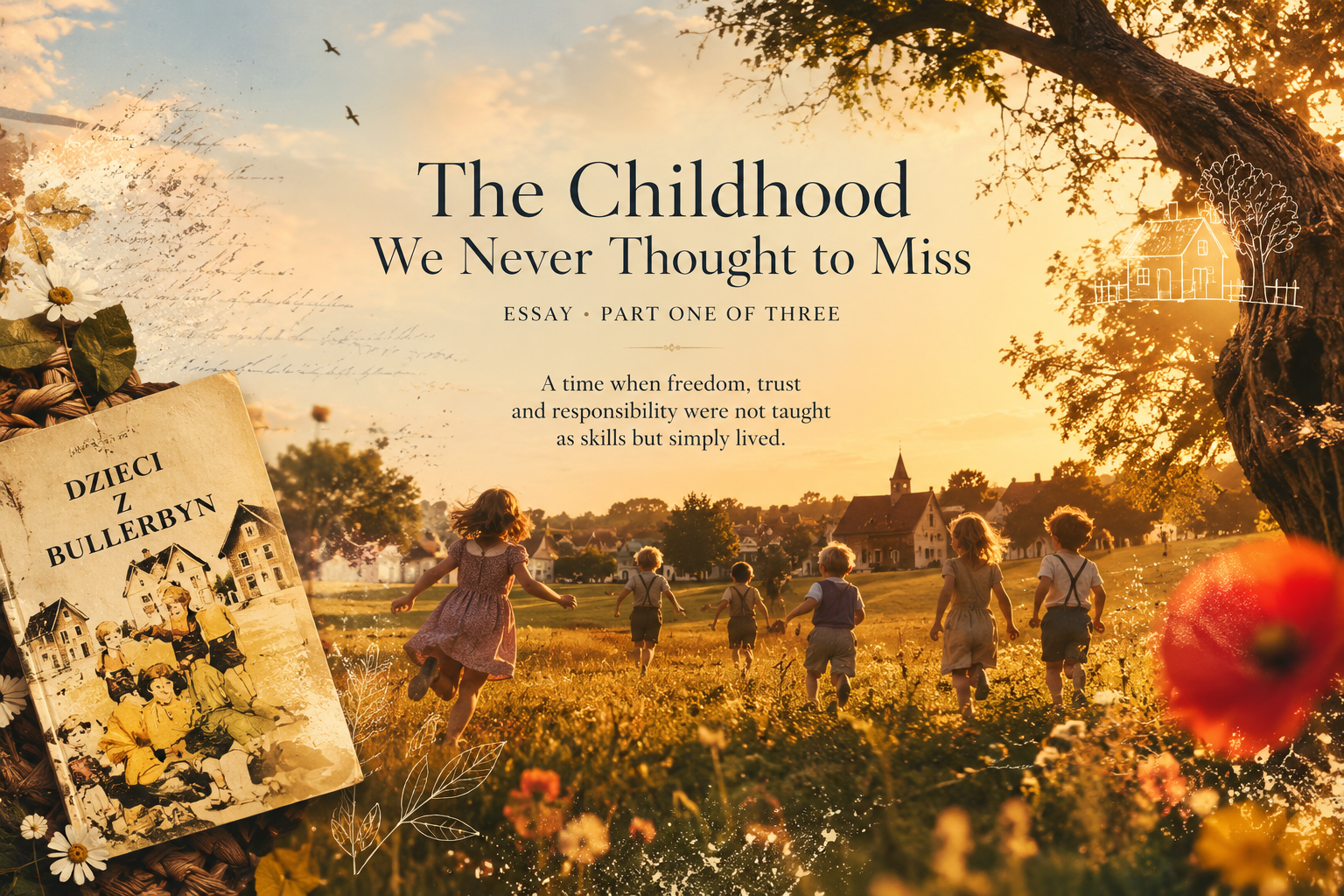
A Personal Essay — Part One
In this essay, I reflect on how one childhood book unexpectedly brought back memories of growing up in Poland—a time when freedom, trust and responsibility were not taught as skills but simply lived. Through personal stories, I explore what childhood looked like then, what has changed, and what we may have quietly lost along the way.
This essay is published as a three-part series. Each part continues seamlessly into the next, together telling one complete story.
I wasn’t planning to think about childhood that afternoon. In fact, I was thinking about something far more modern—children’s independence. It is one of those expressions that quietly found its way into every parenting book, every nursery brochure and every educational conference. We measure it, encourage it, celebrate it and, if we’re being honest, worry about it a little too much. The more I thought about it, the more I realized how curious it was that everyone seemed to know how to teach independence, yet almost nobody stopped to ask where it came from in the first place.
Then, without warning, The Children of Noisy Village (Dzieci z Bullerbyn) came into my mind.
Not because I suddenly wanted to read it again, but because I realised that, as children, we never saw those six children as remarkable. We never admired them for being adventurous or independent. It never crossed our minds to think, What extraordinary children! They were simply… children.
And, in many ways, so were we.
Perhaps that is why that little book has stayed with generations of Poles. We weren’t reading about Sweden. We were reading about a childhood that felt strangely familiar. Different houses, different names, the same muddy knees.
As I sat there, I wasn’t remembering the story anymore. I was remembering my own.
The first thing that came back wasn’t a picture.
It was a voice.
My grandmother’s.
I could almost hear her standing outside the house, her voice travelling across the fields.
“Aneta! Come and eat before the soup gets cold!”
That was all it took.
No mobile phones.
No smartwatches.
No parents sending messages asking where we were.
Just one determined grandmother standing outside the house, convinced that if she shouted loudly enough, the wind itself would carry her words.
And somehow, it always did.
The wonderful thing was that she was never the only one.
If you stood still for a moment, you could hear another grandmother calling from somewhere behind the church, another mother shouting from the next road, another grandfather whistling for his grandchildren to come home. It was as though the whole village breathed together. Names floated through the warm afternoon air while children appeared from places adults probably didn’t even know existed.
Some climbed down from trees.
Some came running across fields.
Others emerged from forests carrying pockets full of things that had seemed terribly important five minutes earlier—acorns, feathers, oddly shaped stones, a beetle they absolutely intended to keep forever, although the poor creature probably had very different plans.
Nobody demanded an explanation.
Nobody asked where we had been.
The only thing that mattered was that the soup really was getting cold.
Lunch never lasted very long because outside was waiting, and outside was infinitely more interesting than anything happening indoors. Nobody organized our afternoons. Nobody planned educational activities or worried whether enough creativity was taking place. Looking back, I sometimes smile when I see expensive toys advertised as tools for developing imagination. We never seemed to struggle with that particular problem.
Give us a stick and, within minutes, it became a fishing rod, a horse, a sword, a magic wand or, if the afternoon required it, all four at once. If someone found an old tire, the whole neighborhood celebrated as though Christmas had arrived early.
People often ask when children became less imaginative.
I sometimes wonder whether the better question is when adults stopped noticing how little imagination actually needs.
We could spend an hour watching a spider patiently rebuild its web after the morning rain had torn it apart. Looking back, I still find that rather amusing because I have always been terrified of spiders. Apparently, my curiosity was stronger than my fear back then. I wasn’t interested in touching it—absolutely not—but I could happily sit a safe distance away, completely fascinated by how such a tiny creature knew exactly what it was doing without attending a single workshop on resilience or engineering. We watched bees feasting on a fallen pear, never stopping to wonder whether they might sting us if we leaned a little too close. Somehow, observing life always seemed more interesting than being afraid of it. We lay in the long grass staring at clouds until one of us announced that the elephant had clearly become a dragon, and somehow everyone agreed. We made flower wreaths, collected shiny stones that had absolutely no purpose other than being beautiful, raced leaves along tiny streams as though we were watching the Olympic finals, and drew roads, houses and entire imaginary worlds on the pavement with white stones because we didn’t have chalk. It never occurred to us that we were missing anything. The road became our sketchbook, the stone became our chalk, and the afternoon disappeared before we even noticed.
I honestly don’t remember being bored.
Not once.
Which is remarkable, considering we had almost nothing people now insist children cannot possibly live without.
No tablets.
No gaming consoles.
No endless choice.
Only endless time.
Perhaps that was the greatest luxury of all.
Looking back now, I don’t think our childhood was perfect. We caught colds, argued with our siblings, came home covered in mud and occasionally managed to lose something that really shouldn’t have been lost. We weren’t happier because life was easier.
We were happier because childhood hadn’t yet become a project.
Adults weren’t trying to optimize every minute of it.
They were busy living their own lives.
And, almost by accident, they gave us the greatest gift they probably never realized they were giving.
They trusted us.
Not with everything.
But with enough.
Enough to disappear into the fields for an afternoon.
Enough to climb one more branch.
Enough to solve our own arguments before running home to complain.
Enough to discover, little by little, that the world was not something to fear but something to get to know.
At the time, none of us thought that was unusual.
We simply called it childhood.
Only years later did I realize that what had once seemed completely ordinary had quietly become something people now describe as extraordinary.


 English
  Polish
2026-07-09 @ 14:07
Great content! Keep up the good work!
2026-07-10 @ 17:42
thank you very much.:-)
Childhood Independence: The Childhood We Never Thought to Miss - Chireveti
2026-07-09 @ 18:08
[…] you’re joining this journey here, you may enjoy reading Part 1 first, where I reflect on the childhood we never realised we would […]
2026-07-10 @ 17:43
to be continue….
The Childhood We Never Thought to Miss- Part 3 - Chireveti
2026-07-15 @ 10:44
[…] @chireveti Life in Plain Sight childhood memories, family memories, grandparents, Growing Up in Poland, love, memoir, nostalgia, parents, Poland, Polish childhood, village life 0 […]
The Childhood We Never Thought to Miss - Chireveti
2026-07-22 @ 19:22
[…] @chireveti Work, Culture & Life 1980s Poland, childhood memories, Growing Up in Poland, memoir, nostalgic storytelling 0 […]
The Childhood We Never Thought to Miss – Childhood Memories of Poland - Chireveti
2026-08-07 @ 10:56
[…] @chireveti Work, Culture & Life 1980s Poland, childhood memories of Poland, Growing Up in Poland, Polish childhood, Winter in Poland 0 […]