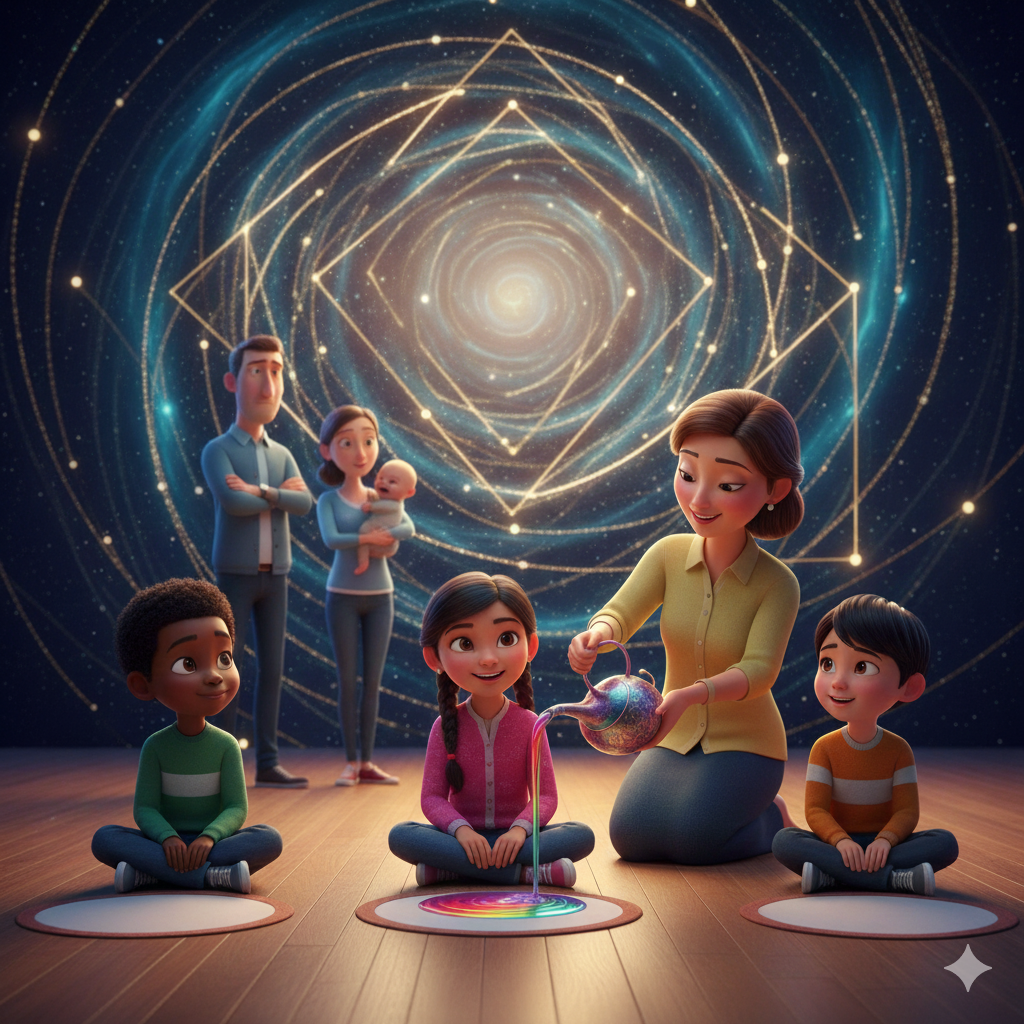
Patience Through Kids, Adults and Jataka Tales
This article uses a Jataka tale to reflect on patience in both children and adults, exploring how learning, growth, and understanding unfold in their own time.
Patience is the chapter nobody asked for but everybody desperately needs — adults especially. Children have a strange, magical ability to wait with the grace of old monks, while adults behave like someone stole their front yard and called it “growth.” It always amazes me how the smallest humans, with the smallest hands and the biggest feelings, can handle frustration like philosophers, while we grown-ups fall apart the moment reality doesn’t align with our calendar.
What the Jataka Knew About Patience
I’ve spent years watching children in classrooms and adults in offices, and let me assure you — patience lives in the kindergarten, not the boardroom. Kids will sit at a table and wait for paint to dry, while adults can’t handle waiting for Wi-Fi to reconnect. Children will take turns, negotiate with a diplomacy the United Nations can only dream of, and breathe through disappointment with the maturity of old souls. Adults? We stew, we snap, we huff, we storm, we gossip, we throw silent tantrums in aesthetically pleasing ways.
And the Jataka tales? They predicted this, of course. They’ve been quietly nodding in the background for centuries, watching us fail the most basic exams of calmness.
The first time patience really hit me, it came from a child so tiny she could barely reach her own backpack. The entire class was lined up to wash hands before lunch, and one boy kept cutting the line, announcing himself as “the fastest hand washer.” The girl in front sighed, took a small step back, and said, “You go. I’ll go after. I’m not hungry yet.” She wasn’t angry, she wasn’t offended, she didn’t need justice or a hero to rescue her. She simply allowed space. She waited. She didn’t lose herself over nonsense.
That was pure Khantivadi Jataka energy — the tale where true patience is not weakness, not silence, not suppression, but complete unshakability. Patience is a form of power that doesn’t need a performance.
Meanwhile, adults… well.
When Adults Forget What the Jataka Taught
I remember working in a place where patience had apparently resigned its job years before I arrived. Everything was urgent. Everything required panic. People snapped at each other like they were sponsored by Stress.com. One afternoon, a minor schedule shift turned into a volcanic emotional explosion that could have powered a small city. And for what? Because someone had to wait an extra five minutes?
Patience in adults is like a limited-edition product — rare, overpriced, and usually out of stock.
And yet, I watched children handle delays with more grace than the entire staff combined. A small boy, waiting for his favourite activity, simply stared at the ceiling and hummed a tune until it was his turn. When I asked him how he’s waiting so peacefully, he shrugged and said, “Because I can wait.” Simple, honest, effortless. Children do this without downloading ten mindfulness apps or reading a book titled How to Be Patient for Beginners. Adults need entire courses.
The adult version of this lesson took me much longer to learn. There was a situation once where every fibre of my being wanted to erupt. Words sat on my tongue like burning coal, but something deeper told me: “Not now. Not these people. Not this battle.”
That moment was my own Sīlavīmaṁsa Jataka — the tale that teaches calmness in the face of accusation, misunderstanding, and the nonsense humans project onto each other. The Jataka reminds us that calmness doesn’t mean acceptance — it means you choose not to drown in someone else’s emotional storm.
Children understand this intuitively. Adults need life to slap them a few times before they even consider it.
One day, a child dropped an entire tray of beads that scattered like confetti across the classroom floor. Instead of crying or panicking, she sat down calmly and said, “This will take long… but okay.” She collected bead after bead with the stillness of someone who already understood the futility of rushing a process. Meanwhile, two adults watching the scene sighed with frustration as if someone had announced tax season early.
Patience is not waiting. Patience is who you become while you wait.
There was also this girl who handled provocation with the elegance adults can only dream of. A boy kept trying to irritate her, poking for a reaction like it was his hobby. She finally looked up from her colouring sheet and said, “You’re making me angry. Go play. I’m busy colouring.” And just like that, she returned to her drawing, treating him like a mosquito buzzing around her personal universe.
And here’s the comedy of adulthood: we lecture children about patience with full confidence. “Wait your turn.” “Be patient.” “What’s the rush?” Meanwhile, if we have to wait in real life, even for something tiny and silly, we evaporate into irritation faster than steam on a frying pan.
A child asks, “Can I have a turn?” We say, “Wait. Patience.” But when we need to wait, even for something small — oh, suddenly patience becomes a mythical creature from fairy tales.
The Cake Test — A Modern Jataka Moment
The perfect example is my husband and cake. The man loves sweets with a devotion saints reserve for prayer. Whenever I bake a cake, he transforms into a human countdown timer. “Is it ready yet?” “Now?” “Maybe check it?” “Why does it take so long?” Every five minutes. And I, trapped between love and volcanic irritation, kept repeating, “It needs time. The cake must bake. And then it needs to cool. This is how cakes work.”
But no. The interrogation continued until my patience took its suitcase and left the house. So I did the unthinkable — I pulled the cake out early and said, “Here. Eat now.” Was it baked? Of course not. Did he deserve it? In that moment — absolutely yes.
And guess what the Jataka would say? Patience saves cakes. Impatience ruins them. A fully spiritual message delivered through half-baked dessert.
And we adults do this all the time. A child starts explaining something, and before they finish the second word, we jump in: “Speak.” “What do you mean?” “No, no, say it properly.” We don’t wait. We insert words into their mouths like we’re editing a script. And then, in a glorious plot twist, we expect them to be patient with our hurry.
Children breathe. Adults accelerate. And then adults complain that life is stressful — no surprise, we live like we’re being chased.
In Poland we say, “Kuj żelazo póki gorące” — strike the iron while it’s hot. A good phrase, wise even. But you know what it doesn’t say? “Strike the iron when it’s half-warm because you’re impatient and want results yesterday.” Even iron needs the right temperature. Life too. You can’t rush everything. Some things need time, heat, cooling, repeating — and patience is the quiet agreement with reality that you don’t get to skip stages.
Most adult frustration doesn’t come from life being hard — it comes from life refusing to obey our schedule. We expect everything immediately: answers, results, apologies, progress, clarity. And when life dares to say “not yet,” we take it as personal betrayal.
Children don’t do this. Children know that waiting is part of the story. They accept time as time. Adults fight it like warriors without swords.
Development, Neuroscience, and Ancient Jataka Truths
Before we get too romantic about children’s natural patience, we need to clarify one important truth so nothing contradicts itself. Children can sometimes wait with calm that surprises us — those moments are real and beautiful. But they are not evidence of a fully developed patience skill. Those calm moments happen because the situation is safe, clear, guided, or because the adult energy around them is steady enough for them to borrow that calm. And the moments when they fall apart — the tantrums, the frustration, the dramatic collapses over tiny things — are not the opposite of patience; they are simply the brain doing exactly what an immature brain does. There is no contradiction. Children are not patient or impatient — they are learning. When they show patience, it is emerging. When they lose it, it is development. And in both cases, they are reflecting the emotional climate we create far more than we realise., let’s remember the part every neuroscientist loves to remind us of: kids don’t actually have fully developed impulse control yet. Their brains are still wiring the skills we adults are supposed to have mastered. When a child throws a tantrum because they can’t have the blue cup, it’s not because they’re dramatic — it’s because their prefrontal cortex is still under construction. They copy our behaviour long before they understand their own emotions. If we slam doors, they learn slamming; if we breathe, they learn breathing. Their impatience is a mirror of ours, just without the adult sophistication of pretending we’re calm. And before we move on, there is one more piece of patience that children embody so naturally it almost feels like a secret language: “when the time comes.” I use this phrase often in class, and the children understand it with a depth most adults never manage. When I tell them something will happen — not now, but when the time comes — they hold that promise with trust. If for some reason it can’t happen, they accept the truth when it’s explained clearly. No drama, no negotiations, no emotional blackmail. Just understanding.
They ask in the cutest way, “When the time comes?” and I say yes, sweets, exactly. And when the time does come, the announcement becomes a festival. Even if it’s something as small as sharpening pencils, starting colouring, or simply making a line. I remember how patiently they waited for paint to be distributed — once the process was explained. Sit in pairs or threes. Wait for your paper. Wait for your brush. Then wait for the paint. And they do. They wait without rush, without complaint, and that moment — when the paint finally arrives — is pure celebration.
Or the way they listen to a story told by a friend. No interruptions. No judgments. Even if the entire story is, “The dragon was big. He blew the trees. Then the superhero came and told him not to burn trees. The end.” They listen as if it’s theatre night. They honour the moment.
This isn’t contradiction. This is patience in its most natural form — patience that grows from trust, clarity, rhythm, and presence.
And that is the real patience lesson — nothing blooms faster just because you’re irritated.
Children master it naturally. Adults relearn it painfully. And somewhere between those two worlds, the Jataka tales smile knowingly, as if to say: “You’re almost getting it.”
Continue the Jataka Series
Explore earlier chapters of the Jataka series to follow the full journey:
Emotions & Hypocrisy: https://chireveti.com/emotional-hypocrisy-of-adults-jataka-tales-today
Compassion Today: https://chireveti.com/jataka-tales-modern-compassion
Courage Unfiltered: https://chireveti.com/courage-diary-of-real-life-bravery



 English
  Polish