The childhood we never thought to miss -part 4
Before You Read
Welcome back to The Childhood We Never Thought to Miss.
This part takes us into winter Sundays in 1980s Poland, where church, family, strict adults, homemade rosół, childhood mischief and songs became memories I would only fully understand years later.
If you are new to the series, start with Part 1 here:
For the previous part, continue tutaj
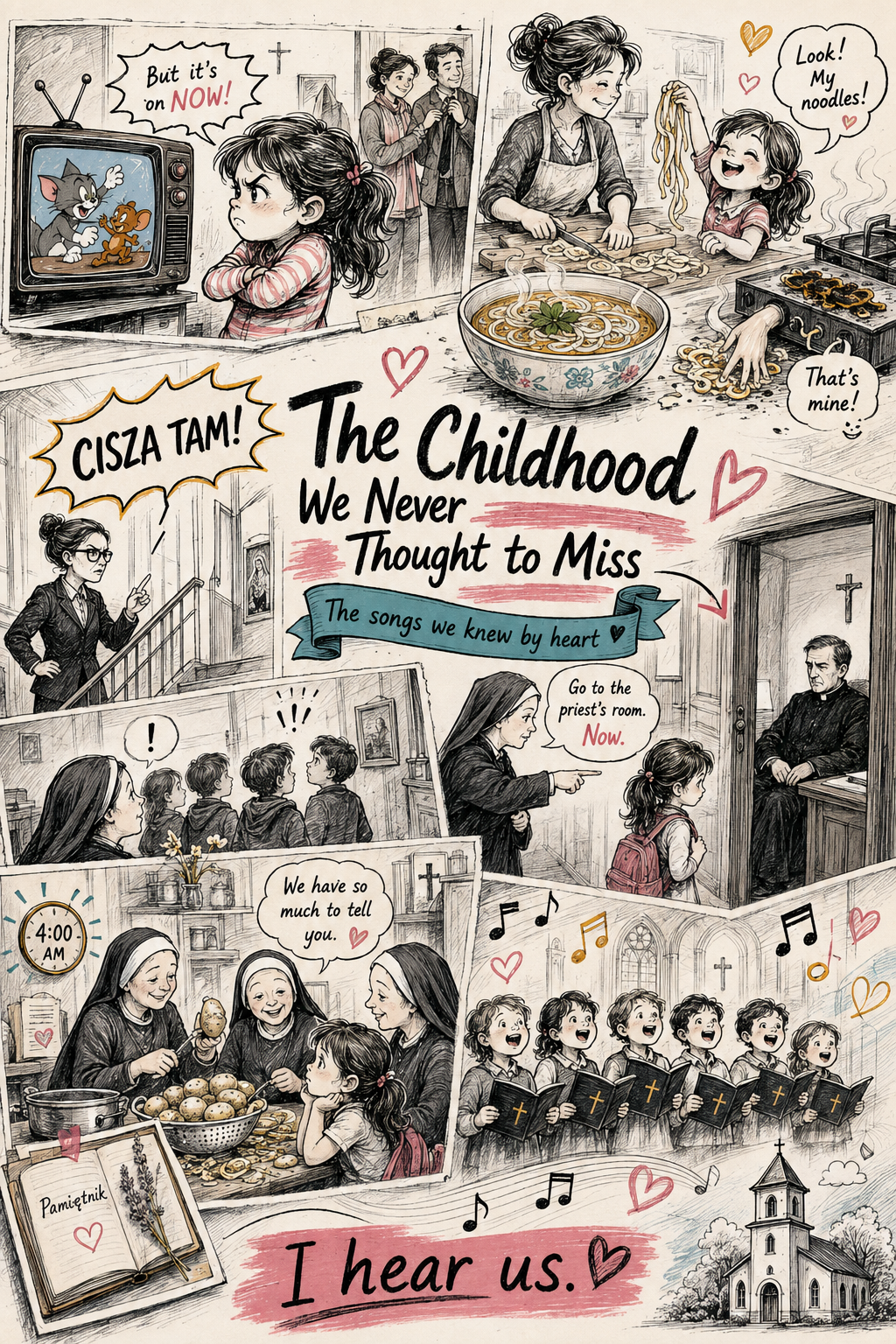
There is a Sunday morning I was desperate not to miss, a bowl of rosół waiting at home, a voice that could silence an entire building, and a punishment that unexpectedly became one of my favourite memories.
And somewhere between all of that, there were songs we knew by heart.
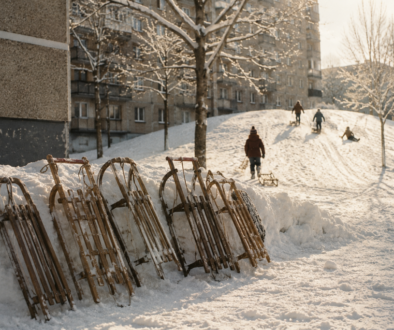
The church stood there every winter just as it did in every other season, but somehow everything felt different when the world outside was covered in snow. We would stamp our boots on the stone steps before going inside, trying to leave as much snow behind as possible, though little puddles always followed us in anyway. The moment the heavy wooden doors closed, silence settled over the space just as gently as the warmth had wrapped us at home after sledging.
As a child, I never saw going to church as something unusual or burdensome. It was simply part of life, just as natural as going to kindergarten or visiting my grandparents. Sunday belonged to church in the same way that Christmas belonged to family and summer belonged to the countryside. Nobody needed to explain why. It was simply what we did.
hat doesn’t mean I always wanted to go.
Some Sundays I was absolutely furious about it.
One particular programme was my favourite, and if it happened to be on a Sunday morning, being told we were going to church felt like a personal injustice. I tried every trick I could think of.
“I don’t feel well.”
“I’m tired.”
“Can’t we go later?”
My parents were not impressed by my creativity.
Negotiating didn’t get me very far. Church was at eleven, and eleven meant eleven.
Television made it even worse because, once you missed a movie, that was it. We had two television shows a day and that was about it. In the morning, children had roughly an hour, starting at nine. Then in the evening there was another little window, perhaps fifteen minutes, usually a cartoon. That was our entertainment.
So if the program you desperately wanted happened to be on Sunday morning, you watched it or you missed it.
And I was not prepared to miss mine.
I would sit there feeling deeply wronged while my parents calmly got ready for church.
Looking back now, it makes me laugh. The things that felt like enormous injustices when we were children become some of the funniest memories later.
And perhaps the consolation was that Sunday had its own reward.
After Mass, we went home to lunch.
My mother usually had everything prepared before we left, and as far back as I can remember, Sunday meant rosół—that golden Polish chicken soup that somehow tasted different from any soup eaten on an ordinary weekday.
And there were always fresh noodles.
My mother made them herself. She would make the dough, roll it out into thin sheets and leave them to dry a little before cutting them into tiny, delicate strips.
I wanted to help, of course.
My noodles were not delicate.
They were more like ribbons.
Somehow a few always ended up on the hot stove, where they curled, crisped and burned. Instead of throwing them away, we ate them.
Those little burnt pieces were sometimes the best part.
Someone would reach over and steal one.
“That’s mine!”
“You weren’t eating it.”
“I was going to!”
“No, you weren’t.”
And somehow the whole thing disappeared before lunch had even properly started.
So perhaps Sunday wasn’t such a terrible day after all.
There was church at eleven, yes.
But there was also rosół, handmade noodles, crispy burnt pieces from the stove and a family gathered around the table.
And, eventually, I stopped being angry about missing the program.
What I remember most about church isn’t even the Mass itself.
It was the singing.
Polish churches have always had a way of filling every corner with voices that somehow became one. As a little girl, I didn’t know anything about harmony or choirs. I only knew that when everyone sang together, the whole church seemed to come alive. The old walls carried every note upward until it felt impossible to tell where the singing ended and the silence began. Even now, whenever I hear one of those hymns years later, I am no longer an adult. I am standing beside my family once again, singing words I had known by heart long before I understood their meaning.
Before long I joined the children’s choir myself.
Looking back, I smile because I don’t think any of us joined because we imagined ourselves becoming singers. We joined because our friends were there, because rehearsals were filled with laughter as much as music and because spending another afternoon together never needed a better reason than simply wanting to be together. Of course we practiced properly. Our choir leader expected us to listen, to learn and to do our best, and somehow we did. We sang during Mass, at special celebrations and whenever the parish needed young voices. Standing there among the other children, trying not to lose my place or begin singing half a verse too early, made me feel strangely proud, even if I was only one small voice among many.
Church wasn’t only about prayers.
It was also where many of the adults who shaped my childhood quietly became part of my life.
One of them was Sister Damaris.
To us she never seemed hurried. She always greeted us with that warm smile that instantly made children feel welcome, as though she genuinely had time to listen to whatever important story a six-year-old had brought with them that day. She taught religion with patience rather than fear, and perhaps that is why so many of us loved those lessons. Children ask endless questions, especially about things they cannot see, and instead of making us feel silly, she encouraged us to keep asking. Looking back now, I think that was one of the greatest gifts she gave us. She taught us that faith and curiosity could exist together.
Of course, not every adult at school or church made us feel quite so comfortable.
There were people we were genuinely afraid of.
Our school director was one of them. Her office was on the second floor, and it was not a place children wandered into casually. If the school became too loud, we didn’t need to see her. Her voice travelled remarkably well through a two-floor building.
“Cisza tam!”
“Quiet in there!”
And suddenly the whole building went silent.
We all knew that voice.
The teachers’ room was another place we didn’t simply walk into. If we needed to speak to a teacher there, we knocked first and waited to be invited in. It never occurred to us that we could just open the door. We knew teachers had their own space, just as we had our classroom and corridors. They had their breaks, their conversations and their time away from us.
We were polite. We were also very aware of where we were supposed to be.
At church, there were adults who gave us much the same feeling. One of the sisters and one of the priests were people we knew to be loving, but we were still a little afraid of them. There was something about the way they carried themselves, the way they spoke and even the way they looked at you that made you straighten up without being asked.
If the priest caught you talking during Mass or during a class, he didn’t need to say much.
One look was enough.
You knew.
You did not talk while someone else was speaking. That was the rule.
The sister was short, but somehow that made no difference whatsoever to the authority she carried.
“Get up now. Go to the priest’s room and explain yourself. What did you do wrong in my class? Right now.”
I remember going there twice.
The first time, the priest asked me what I had done.
“I wasn’t listening,” I admitted.
That was apparently enough of an answer.
Instead of sending me straight back, I was told to sit with the other sisters and watch them peel potatoes.
At the time, I thought I was being punished.
I had no idea I was about to learn something I would remember for the rest of my life.
The sisters talked while they worked. They told us about preparing food for everyone and doing things themselves. They got up as early as four in the morning for Mass, prepared for the day and then carried on with all the duties waiting for them. They cleaned the church, helped people who needed it and somehow found time to sit with us and tell us the stories they believed God wanted them to share.
They were not living in some mysterious world apart from ordinary life.
They cooked, cleaned and worked.
Of course they got tired too.
They woke before most of us had even opened our eyes.
And yet they waited so patiently for their moments with us, ready to tell us what they had come to share.
I didn’t understand any of that then.
I only knew that I had been sent there because I had been talking when I shouldn’t have been, and somehow I ended up sitting beside a group of women peeling potatoes and listening to stories.
Years later, I understood that the lesson had nothing to do with potatoes.
It was about service, responsibility and the quiet work people do for others without expecting anyone to notice.
I simply wasn’t old enough to recognise it yet.
One afternoon, after religion class, Sister Damaris asked me to stay behind for a moment. I remember watching the other children disappear through the doorway while I stood there wondering whether I had forgotten something or done something wrong. Instead, she smiled and reached for my Pamiętnik (autograph book or friendship album). It wasn’t a diary, as the English word might suggest. It was a little book where friends, teachers and people who meant something to us wrote poems, wishes and words we hoped would stay with us forever. Every new entry felt like discovering a tiny treasure.
She opened it carefully, paused for a moment, and then, in her neat, elegant handwriting, wrote:
„Największe szczęście jest czyste sumienie,
i tego nikt Ci zabrać nie może,
ono cenniejsze niż drogie kamienie,
jego nagrodą jest Królestwo Boże.”
The greatest happiness is a clear conscience,
and no one can ever take it away from you.
It is more precious than the most expensive jewels,
and its reward is the Kingdom of God.
I have carried those words with me ever since.
The English translation tells you what she wrote, but somehow it doesn’t carry quite the same warmth. Polish has a way of making certain sentences feel less like advice and more like a gentle blessing. Every time I read those familiar words, I don’t just remember what they mean. I remember the person who wrote them, the quiet smile on her face, the classroom, the scent of chalk and polished wooden desks, and the feeling that someone believed a few carefully chosen words might accompany a little girl for the rest of her life.
She was right.
They did.
There were many wonderful people in my childhood, but what stayed with me was not simply what they told us. It was the way they made room for questions.
How could God hear millions of people praying at the same time?
Where did angels stay when nobody could see them?
Did animals go to heaven?
We asked everything that crossed our curious little minds. Some questions probably made adults smile, but I never remember anyone making us feel foolish for asking.
Perhaps that is why church never became a place of obligation for me. There were rules, certainly. There were adults we were afraid of, and there were moments when we knew very clearly that we had crossed a line. But there was also singing, curiosity, laughter and people who quietly showed us what care looked like in everyday life.
The choir became another little family. Rehearsals were filled with far more laughter than perfection, and although we always tried our best, there was usually someone who came in too early, someone who forgot the words and someone who couldn’t stop giggling at exactly the wrong moment. Somehow our choir leaders managed to keep wonderfully patient faces through it all. We learned that singing together wasn’t really about having the most beautiful voice. It was about listening to one another, breathing together and becoming part of something much bigger than ourselves.
We didn’t know then that one day those ordinary Sundays would become memories. At the time, they were simply Sundays. We sang, we laughed, we went home. Nothing about them felt important enough to remember forever.
I don’t remember how many hymns we learned back then. I couldn’t tell you how many times we sang them, or how many Sundays we stood together in that choir.
But I still remember the feeling.
All those little voices rising together beneath the old church roof, sometimes perfectly, sometimes not at all.
And perhaps that is why, even now, when I hear one of those songs, I don’t hear only music.
I hear us.


 English
  Polish