AI in Early Childhood: What It Can’t See
I keep hearing that the world is changing fast, and that AI in early childhood is now part of how education must “keep up” with what is coming. Every few months there is a new tool, a new platform, a new promise that this time learning will finally be easier, faster, more personalized. And every time, I find myself looking not at the technology, but at the children in front of me, and asking a much quieter question: what is actually changing for them?
When you spend years on the floor with small children, you stop believing in shortcuts. You see how learning really happens. It happens when a child pours water and spills it, freezes for a second, and looks at you — not for help, but to understand what kind of world this is going to be. A world where mistakes are a problem, or a world where we grab a cloth and clean together. It happens when a child struggles to thread a needle, gets frustrated, walks away, then comes back and tries again with slower hands. No one taught that patience. It arrived on its own.
This is early childhood learning. It is physical, emotional, relational. And it is slow.
When AI Enters the Room
I’ve used AI with children myself. It can be fun. Children are curious, engaged, playful. I wrote earlier about this balance in AI in early childhood education, where I looked more closely at how technology can exist in children’s lives without replacing curiosity, play, and real problem-solving. That curiosity matters and should not be dismissed.
What I watch closely, though, is what happens next. Do they continue exploring when the tool stops responding? Do they try another way when there is no immediate feedback? Or do they pause, waiting for the screen to lead?
When the balance is right, AI stays in the background. It supports, but it does not steer. The moment it starts thinking for the child instead of with the child, something shifts. You see it first in their body. Less leaning in. More waiting.
Learning Is Not Efficient — and That Matters
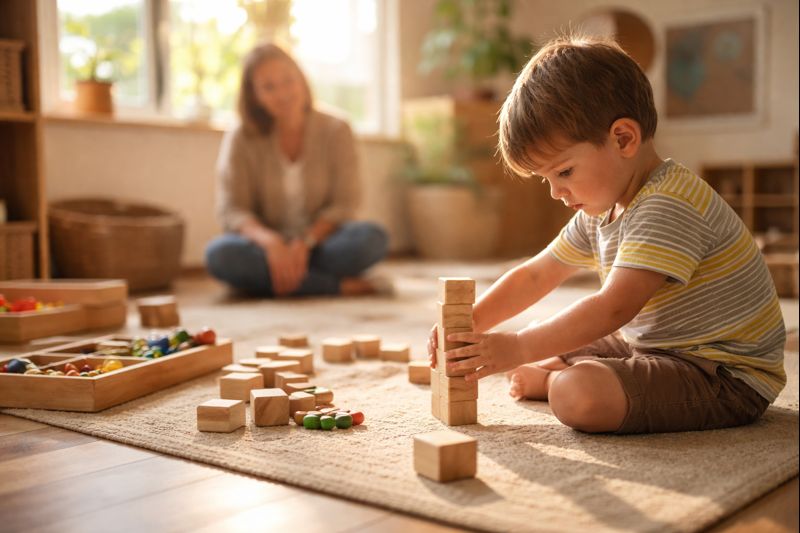
In real classrooms, learning is messy. It is loud, repetitive, and often boring long before it becomes meaningful. I have watched children argue for twenty minutes over how to build a bridge with blocks, only for it to collapse as soon as they finish. Then they sit quietly and rebuild — not because anyone told them to, but because they want to understand what went wrong.
No app would allow that much frustration. No system would optimise for that kind of learning.
Boredom plays a role we rarely acknowledge. When nothing is offered, suggested, or filled in, children begin to invent. They negotiate, imagine, and decide for themselves. When every gap is filled, they don’t get lost — but they also don’t get found.
The Quiet Risk: Compliance
What worries me most about AI in early education is not screens or intelligence. It is compliance.
Children are quick to learn what earns approval. When learning environments respond instantly, evaluate constantly, and guide every step, children begin to perform early. They get good at reading prompts, avoiding mistakes, and waiting for feedback. It looks like success. But it is a fragile kind.
Efficiency is not the same as understanding.
Technology Is Not New — Dependency Is
I grew up with technology arriving slowly. Computers were learned deliberately. I took courses. I learned commands, DOS screens. It was not magic and it was not everywhere. It was a tool you had to understand in order to use.
What we were never taught was how to relate to technology. When to use it. When not to. What it should support — and what it should never replace. So we learned by overuse.
Now many adults cannot navigate without a phone, remember numbers, or tolerate not knowing for a few minutes — not because we are incapable, but because we outsourced too much, too early.
I see the same risk forming for children.
Teaching the Relationship, Not Just the Tool
The problem is not AI. The problem is the absence of guidance.
Schools often introduce technology without teaching boundaries. Children learn how to use tools, but not how to stop using them. How to access answers, but not how to think first.
AI can have a place. It can support teachers, reduce administrative load, help children revisit ideas, explore language, or check understanding. But it should never replace struggle, decision-making, or lived experience.
Children need to know — clearly — that their brain comes first. Their body comes first. Their real-world experience comes first. Technology comes after, in service of that life, not instead of it.
What Childhood Actually Needs
Childhood does not need upgrading. It needs protecting — not from the future, but from being thinned out.
If a tool makes learning faster but makes childhood smaller, I step back. Not out of fear, but out of respect for development.
Children are not behind. They are not late. They are not raw material for the future. They are humans now, learning in the only way humans ever have — through their bodies, their relationships, their mistakes, and their time.
If we remember that, we will make better choices.
If we forget it, no amount of intelligence — artificial or otherwise — will give back what we quietly take away.



 English
  Polish