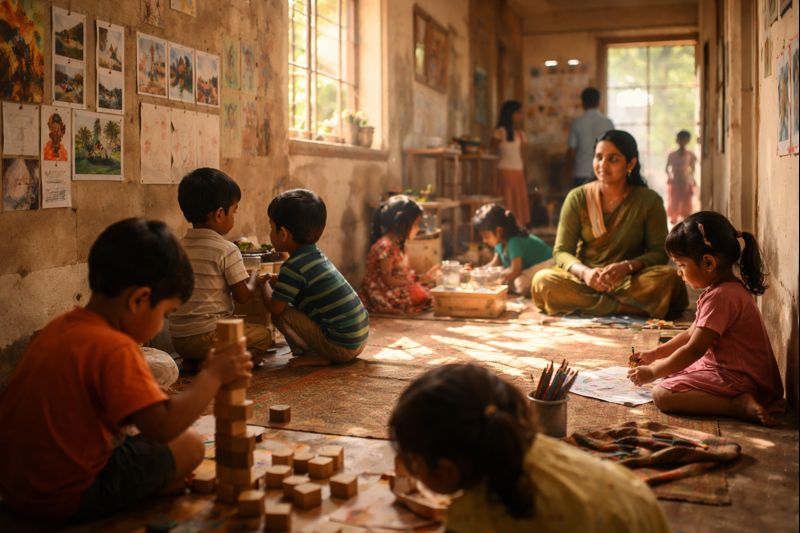
This article reflects on the reality of IB Early Years in India, beyond philosophy and frameworks. It explores how the programme translates into everyday classroom life, the pressures teachers carry, and what children actually experience when learning unfolds in real time.
After years inside IB Early Years in India classrooms in India, one thing feels clear to me now: the programme itself was never the problem. The tension has always lived in the space between intention and translation.
When IB first found its footing in India, it arrived dressed in philosophy. Inquiry. Learner agency. International-mindedness. We learned the language quickly. We spoke it fluently. It sounded right, and in many ways, it was. But Early Years classrooms have a way of testing ideas without mercy. Young children are not impressed by frameworks. They don’t respond to philosophy. They respond to what actually happens to them every single day.
For a long time, success in IB schools was measured by alignment. Planners completed. Learner profile attributes visible. Displays articulate enough to reassure adults. Early Years classrooms, in particular, slowly began to resemble smaller versions of upper PYP spaces — rich in documentation, heavy in explanation, and often short on uninterrupted time. Play was present, but it had to justify itself. Inquiry existed, but frequently within boundaries already drawn. Children were free to “discover,” as long as they arrived where we expected them to.
IB has begun to acknowledge this tension in recent years. Its research focus has shifted — away from reputation and theory, and towards implementation, wellbeing, and curriculum refinement. That shift didn’t appear out of nowhere. It reflects what many educators had been sensing quietly for a long time: a programme can be conceptually strong and still feel oddly disconnected from a child’s lived experience.
A child does not experience a programme.
A child experiences pace. Tone. Permission. Whether someone is truly listening.
In many Indian IB Early Years and PYP classrooms today, we have slowly confused visibility with value. Play began needing defence. Learning began needing proof. Inquiry began needing to look impressive. This wasn’t born out of poor teaching. It grew out of pressure — pressure to reassure parents, leadership, visitors, inspections, rankings.
The result is classrooms where teachers work extraordinarily hard, often in service of performance rather than presence.
Teachers attend workshops, update planners, write reflections, collect evidence, prepare displays, and manage expectations — all while holding space for children who need repetition, movement, silence, and risk. Many are doing the work of air-traffic controllers while also being asked to nurture curiosity. It’s like being asked to cook a slow, nourishing meal while constantly checking whether the table looks good for guests who may or may not arrive.
This pressure shows itself clearly in how display boards are used.
Many teachers are never taught the real purpose of displays. Boards are created to impress leadership or visiting teams, not to speak to children. Corridors fill with academic language that sounds intelligent but belongs to no one. Adults read it politely and move on. Children walk past their own learning and don’t recognise it.
And yet, when displays are done with intention, the shift is immediate.
This is where Making Learning Visible matters — when it is understood properly. When boards show the journey instead of the conclusion. When they use children’s words instead of borrowed vocabulary. When they capture moments rather than outcomes. Classrooms and corridors change. Children stop. They remember. They point. They explain to parents and visitors — not because they were told to, but because they lived those moments. The learning belongs to them.
I’ve written earlier about this deep respect for Making Learning Visible — not as decoration, but as memory, identity, and voice. That reflection lives here:
https://chireveti.com/making-learning-visible-early-education
Ironically, the less “academic” the language, the more intelligent the space becomes. A school filled with authentic learning journeys feels less like a museum and more like a home. One impresses. The other is lived in.
In schools where IB truly works, you feel it almost immediately. There is less performance and more trust. Teachers speak less and observe more. Planning responds instead of predicting. Documentation serves reflection, not fear. Displays speak to children first. Play is not defended — it is treated as serious work.
These classrooms don’t feel staged. They feel human.
The difference, almost always, is leadership.
Leaders who understand the programme deeply, who value childhood more than compliance, and who trust teachers enough to let learning look unfinished create conditions where IB can breathe. Without this, even well-trained teachers eventually slip into survival mode. Endless documentation, constant training, and over-explaining are often fear disguised as rigour — anxiety printed neatly on A4 paper.
Some experienced IB voices are beginning to name this now. Quietly. Carefully. Not to criticise the programme, but to protect it.
IB was never meant to be a race. Yet many schools behave as if childhood is a conveyor belt — Early Years preparing for PYP, PYP preparing for DP, everyone rushing children towards the next station. Childhood is not a departure lounge. Some children need to sit on the floor longer. IB allows this. Systems often don’t.
The most important question remains the simplest one: if this school disappeared tomorrow, what would the child carry with them?
Not unit titles.
Not key concepts.
But the memory of being trusted. Being waited for. Being allowed to try again. Of seeing their thinking respected enough to be left on the wall, just as it was.
IB in India does not need more polish.
It needs more courage.
The courage to slow down.
The courage to trust children.
The courage to trust teachers.
Because a programme that fears mud, noise, boredom, repetition, and child-made mess is not an Early Years programme at all.
It’s just a very expensive suit worn to a picnic.
And children, as we know, always sit on the grass anyway.
What is the core issue in implementing IB classrooms in India according to the article?
The core issue is the gap between the original philosophy of the IB programme and how it is translated into practice, often resulting in classrooms that are more about performance and compliance than genuine learning and child engagement.
How have Indian IB Early Years classrooms changed over time, and what impact has this had on children?
Indian IB Early Years classrooms have become more focused on documentation, displays, and proving learning, which often diminishes opportunities for free play and authentic inquiry, affecting children’s real engagement and joy in learning.
What does Making Learning Visible (MLV) aim to achieve in early childhood classrooms?
MLV aims to show the learning journey through children’s own words and moments, helping to create a space where children feel ownership over their learning and classrooms become familiar, lived-in places of genuine growth.
What are the characteristics of a truly functional IB classroom for young children?
A truly functional IB classroom is characterized by trust, less performance pressure, authentic play, attentive observation, reflection on practice, and leadership that values childhood over mere compliance, creating a human and nurturing environment.
According to the article, what is the most critical factor determining the success of IB education in India?
The most critical factor is leadership that understands and values the programme deeply, trusts teachers and children, and is courageous enough to slow down and prioritize genuine learning over performance metrics.


 English
  Polish
2026-03-26 @ 21:09
whoah this weblog is fantastic i love reading your posts. Stay up the great work!
You realize, many individuals are looking around for this
information, you can help them greatly.
2026-03-27 @ 14:10
Thank you — I’m glad it spoke to you.
Most people see the surface of education. Very few see what actually happens inside a classroom. That gap is where the real work sits.
If this felt familiar, it probably means you’ve seen it too.