A Different Kind of Freedom - part 4
Zanim zaczniesz czytać
Witamy ponownie w Dzieciństwo, za którym nigdy nie sądziliśmy, że będziemy tęsknić.
This chapter continues the story of my childhood growing up in 1980s Poland, moving between two very different worlds: my grandparents’ peaceful village and our fourth-floor flat in Łódź. If you’ve just discovered my memoir, I warmly invite you to begin with the earlier chapters to experience the journey from the very beginning.
👉 Start with Part 1 tutaj
Leaving my grandparents’ village never felt like leaving one childhood behind and returning to another. To me, they were simply two halves of the same world, stitched together so naturally that I never questioned it. One week I could be running barefoot through fields that seemed to have no end, and the next I would be standing at the window of our fourth-floor flat in Łódź, watching people hurry across the courtyard below while wondering which of my friends would be the first to knock on our door. Children never compare worlds. They simply live inside whichever one they wake up in.
Life in the city had its own rhythm, one that moved to the sound of footsteps echoing through old staircases, neighbours greeting one another from open windows and the comforting smell of fresh bread that somehow found its way into every street long before the bakery itself came into view. Even today, whenever I catch that unmistakable scent of warm bread just coming out of the oven, I don’t think about bakeries first. I think about home.
My father spent long periods working abroad, and although I never truly understood why, I knew that every time he returned something inside our little flat changed. My mother’s smile seemed lighter, laughter came more easily, and ordinary evenings somehow felt like small celebrations without anyone needing a special reason. Looking back now, I realise that children measure time very differently. We didn’t count weeks or months. We counted homecomings.
Sometimes those homecomings brought little miracles with them. I still remember walking into Baltona holding tightly onto one of my parents’ hands. At that age I had absolutely no idea why this shop seemed different from all the others. I didn’t understand foreign currency, imported goods or why not everyone simply walked in and bought whatever they wanted. All I knew was that everything looked unusual. The shelves seemed fuller, the packaging brighter, and there was a feeling in the air that made every visit feel like an occasion rather than an ordinary shopping trip. To a little girl, it was impossible not to believe that magical things lived there.
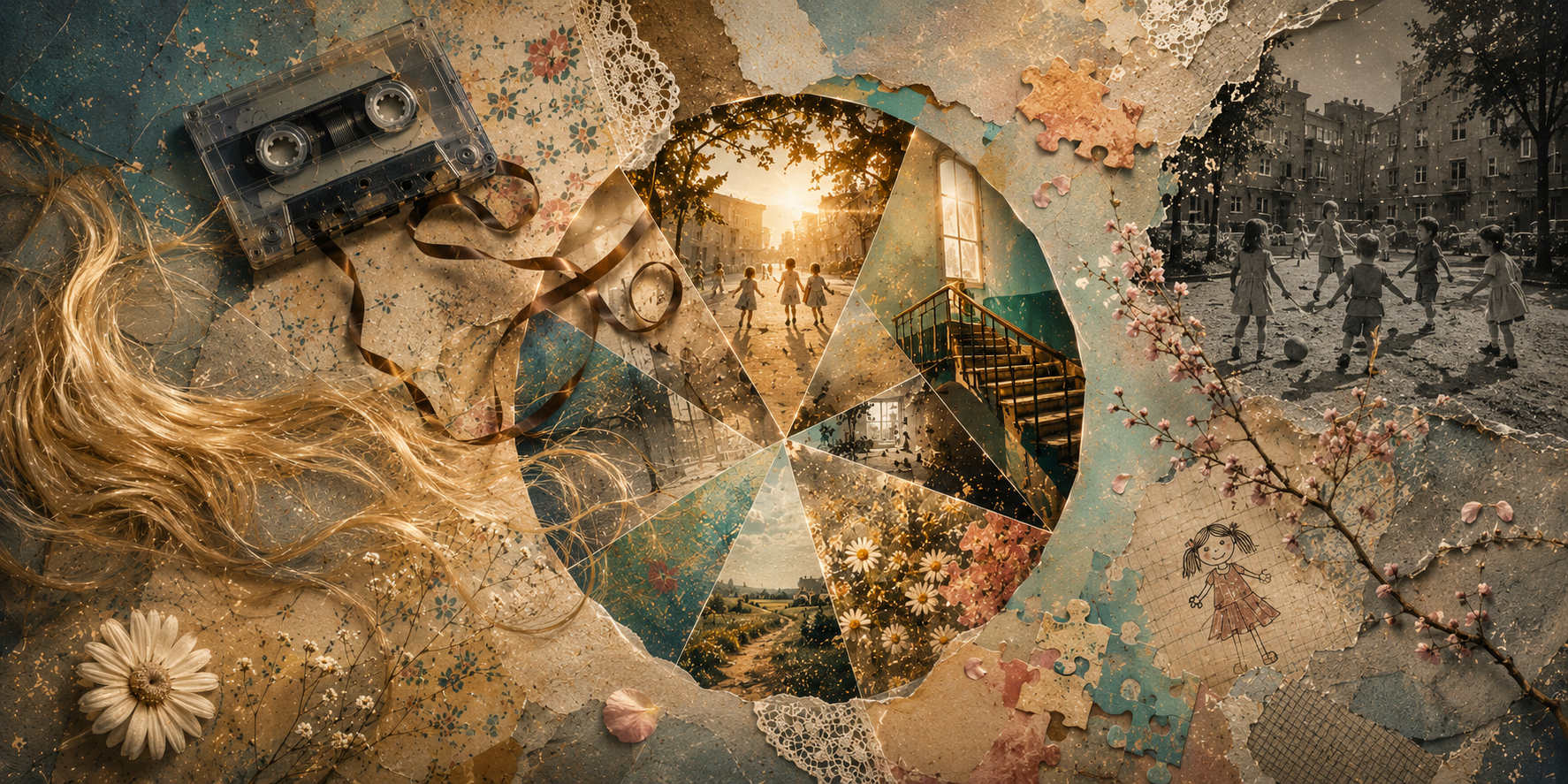
One day one of those magical things came home with us—a cassette recorder.
Today it would probably look rather ordinary sitting on a shelf somewhere, but then it felt as though someone had brought music itself into our living room. We no longer had to wait and hope that our favourite song would come back one day. Now there was a chance of keeping it forever. Whenever we heard the first familiar notes coming from the radio, someone would shout through the flat and a race would begin. One person reached for the recorder while another desperately waited with a finger hovering above the record button, praying the presenter would stay quiet just a little longer. Sometimes we won. Sometimes his cheerful voice proudly introduced the song halfway through the first verse or thanked everyone for listening just before the ending. We laughed, complained for a moment and then listened to it anyway, because somehow even his interruptions became part of the song we remembered years later.
Another time my father returned carrying a present that instantly became the most beautiful doll I had ever seen. She had long golden hair that reached almost to her waist, bright blue eyes that opened and closed, tiny clothes carefully stitched together and a little bottle that allowed me to feed her. She even wet her nappy afterwards, which convinced me she was practically a real baby. I adored her.
Then one afternoon I overheard my grandmother saying something that sounded wonderfully sensible.
“If you cut a child’s hair,” she told my mother, “it grows back thicker and stronger.”
The adults carried on talking, never noticing that I had quietly slipped away, armed with complete confidence and a pair of scissors after what I believed to be excellent parenting advice.
I carefully sat my beautiful doll in front of me, stroked her long blonde hair one last time and then, with absolute determination, cut every single strand off.
I wasn’t being naughty.
I wasn’t being destructive.
I genuinely believed I was helping her.
Soon she would have even thicker, healthier, more beautiful hair than before.
When the adults discovered what I had done, the expressions on their faces suggested that perhaps they hadn’t expected their conversation to become practical instruction quite so quickly. I remember looking at them in complete confusion. Hadn’t I done exactly what they had said? It took many years before I realised that adults often speak to one another without imagining that little ears are listening to every word, carefully collecting pieces of wisdom and immediately putting them into action.
While my father’s homecomings brought little adventures of their own, the quiet heartbeat of our everyday life was always my mother.
Only now, looking back as an adult, do I understand how much she carried on her shoulders while my father worked away from home. At the time, none of it looked difficult. Lunch somehow appeared on the table every day, clothes somehow became clean again, beds somehow made themselves, and cupboards never seemed completely empty. Childhood has a wonderful way of hiding sacrifice behind ordinary routine.
Yet even my mother occasionally forgot something.
She would already be halfway through cooking when suddenly she stopped stirring the pot, smiled to herself and called one of us into the kitchen.
“Aneta…”
Or sometimes both my brother and me together.
“I forgot the cream.”
Or the bread.
Or milk.
Sometimes butter.
Sometimes potatoes.
Sometimes parsley.
Sometimes something so ordinary that I can no longer remember exactly what it was.
Within minutes we were back on the staircase, shopping bag swinging from one hand, already racing towards the bakery before she could even remind us not to run. Not because we loved shopping, but because we loved what came afterwards. If we hurried, didn’t waste time and came straight back, we earned a few extra precious minutes outside.
To a child, there was no greater reward.
And there was certainly no worse punishment than hearing the words,
“You’re not going outside today.”
Nothing else compared.
Not losing a favourite toy.
Not being sent to our room.
Not even being told off.
Staying indoors while every other child was outside felt as though the entire world was happening without you.
The moment permission was finally given, we flew out of the flat before anyone had the chance to change their mind. Looking back now, I honestly don’t remember ever walking down those stairs. We always ran. Two steps at a time if we were feeling sensible, three if we were in a hurry, and sometimes four if courage happened to be greater than common sense. Every landing became another finish line before the next race began, our feet echoing so loudly through the stairwell that the neighbours must have known exactly which children were coming. I still wonder how neither my brother nor I ever broke a leg. Perhaps childhood has its own invisible guardian, quietly catching children before gravity has the chance to teach them a lesson.
The handrail was an adventure all by itself. Officially, it was there to stop people from falling. To us, it was the fastest way to reach the ground floor. Every adult told us not to slide down it, which naturally convinced every child in the building that sliding down it was precisely what it had been designed for. One quick jump, both hands gripping the smooth wooden rail, and away we went, trying to reach the bottom before somebody opened their front door and caught us halfway down. Sometimes we managed. Sometimes we didn’t. The disapproving look waiting at the bottom lasted only a few seconds, while the thrill of the ride stayed with us all afternoon. It seemed like a fair exchange.
The entrance to the building was the finish line, and the moment we burst into the courtyard it became our kingdom. Nobody organised us. Nobody arranged playdates or checked who would be there. Children simply appeared, almost as if the buildings themselves quietly released us into the afternoon. Within minutes every corner echoed with laughter, bicycles rattled over uneven pavements, skipping ropes slapped against the ground, somebody shouted that another game was starting, and before we knew it the whole courtyard belonged to us once again.
To be continued…
 English
  Polish
The Childhood We Never Thought to Miss: Polish Childhood Games - Chireveti
2026-07-30 @ 10:43
[…] with Part 1, where my journey through childhood in Poland begins. If you’ve read the previous chapter, this story continues from the moment we ran into the […]