An honest reflection on intercultural marriage, emotional loneliness, identity, adaptation, and the quiet ways people can slowly disappear inside long relationships while everything still appears “fine.”
This article explores love, emotional labor, cultural differences, and the moment a woman finally becomes quiet enough to hear herself clearly again.
There should almost be an entire drawing room reserved for foreign women married to Indian men. A softly lit room filled with tea, emotional confusion, and the sentence: “No, no, everything is fine,” repeated by women whose eyes suggest otherwise.
Not because Indian men are terrible men. Life is rarely that simple and human beings even less so.
And certainly not because Polish women are innocent creatures floating through marriage in white linen and emotional wisdom. We can be sharp, restless, dramatic, impatient, too honest for comfort, and occasionally emotionally theatrical before breakfast.
No. The difficulty lives elsewhere.
It lives in the silent distance between two people who love each other sincerely yet were raised inside entirely different emotional civilizations.
I write this not as an expert. At times I understand very little myself. Most days I do not even possess the correct words for what I feel. I simply feel it sitting somewhere in the body like an unanswered letter.
And maybe that is exactly why I suspect many women will understand this article immediately.
Because there is a particular exhaustion that appears in intercultural marriages after enough years pass. Not dramatic exhaustion. Not cinematic tragedy. Something quieter. More elegant. More dangerous.
The exhaustion of constantly translating your inner world.
Nobody warns you that in some intercultural marriages the foreign woman slowly becomes relationship therapist, cultural translator, emotional regulator, social adapter, and public diplomat simultaneously — while still being called “too emotional” for eventually collapsing under the weight of it.
You begin the marriage believing language will be the challenge. In reality, language is the easiest part.
The true difficulty begins later, when two people suddenly discover they inherited completely different understandings of closeness, family, silence, obligation, apology, independence, marriage, and love itself.
A Polish woman says she feels emotionally alone. She means precisely that.
An Indian man often hears accusation hidden inside the sentence. Failure. Pressure. Criticism.
She asks for emotional presence. He responds with responsibility.
She longs for conversation. He offers solutions.
She wants truth spoken directly into the room. He wants peace maintained around the room.
And so both people slowly begin missing each other while standing only a few feet apart.
The woman becomes “too emotional.”
The man becomes “emotionally unavailable.”
Both feel unseen.
Both feel misunderstood.
Both quietly begin defending themselves instead of meeting each other.
And still the marriage continues.
That is the part nobody explains honestly enough.
These marriages often survive not because they are deeply fulfilled, but because they are not entirely broken either.
There is love there. Real love. Shared history. Children perhaps. Loyalty. Friendship. Habits built over years. Small kindnesses. Familiarity. Concern. Sometimes even tenderness hidden under exhaustion and misunderstandings.
Which is precisely what makes leaving so difficult.
People imagine unhappy marriages as constant storms. In truth many marriages die slowly in polite weather.
There are marriages where nobody screams, nobody cheats, nobody leaves… and still a woman feels herself disappearing molecule by molecule inside daily politeness.
Sometimes the loneliness does not arrive during dramatic fights. Sometimes it arrives while sitting beside the same man for the seventh evening in silence, both scrolling separate phones, both exhausted, both decent people, both emotionally somewhere else entirely.
I look at modern relationships today and I do not feel particularly encouraged either. People speak endlessly about communication while barely listening to each other. Everyone demands understanding while arriving already armed for defense. Vulnerability became a social media performance. Intimacy became negotiation. Attention spans disappeared entirely.
So no, this is not an article declaring one culture superior to another. European marriages collapse beautifully too. We simply ruin relationships in different styles.
But there is something uniquely lonely about being a foreign woman inside a culture where emotional language between men and women is often shaped differently from what you knew before.
Many Indian men were raised with enormous pressure resting quietly on their shoulders long before adulthood arrived. Financial responsibility. Family duty. Social expectations. Emotional restraint. Stability above self-expression.
Then they marry women raised to believe partnership includes emotional transparency, verbal intimacy, mutual psychological presence, and direct confrontation of problems before they become emotional fossils.
Naturally both sides become tired.
Sometimes I think foreign women in India slowly become emotional diplomats without realizing it. We learn timing. Tone. Which truths are acceptable. Which emotions create silence. Which conversations must wait. Which honesty sounds too sharp inside another culture.
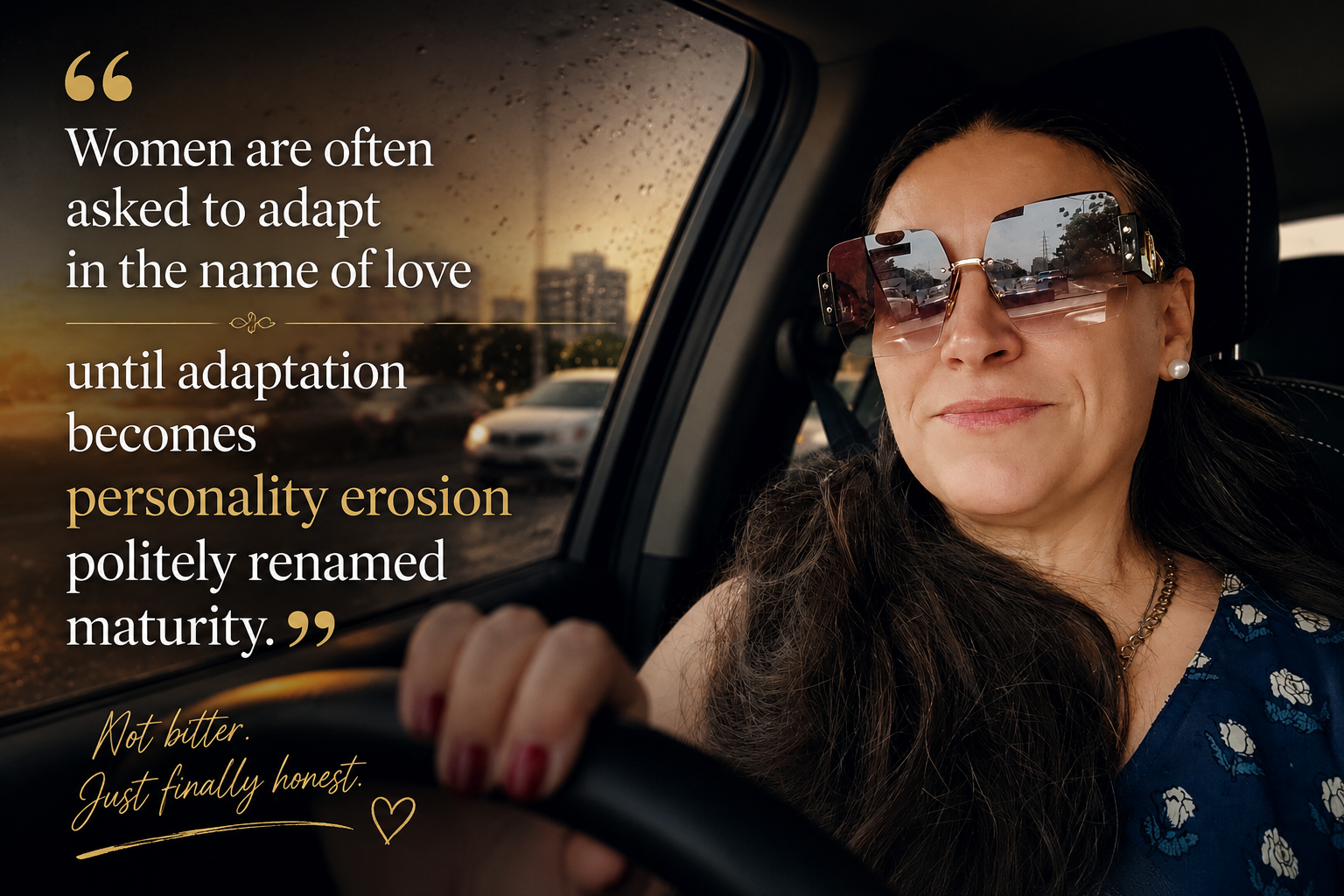
Women are often asked to adapt in the name of love until adaptation becomes personality erosion politely renamed maturity.
Sometimes I do not even know if I miss Poland, younger love, emotional safety, or simply the version of myself that once spoke without calculating consequences.
There is also a strange loneliness in realizing that after enough years abroad, nobody around you fully remembers who you were before adaptation became survival.
Even now, although I am opening myself more honestly, the voices are not entirely silent.
“Measure it first.”
“Think carefully.”
“Soften the sentence.”
“Do not make it too emotional.”
“Too direct.”
“Too uncomfortable.”
And then occasionally something inside answers back:
Nie.
Not angrily. Not dramatically. Simply truthfully.
No. I want to exist fully inside my own life again.
Of course, there are also relationships built beautifully. Deeply. Honestly. I am generalizing here, and life is always more nuanced than any article can hold. Some couples truly grow together through cultural difference instead of slowly disappearing inside it.
And this stage does not arrive immediately either.
When I was younger, much of it felt easier. Perhaps I ignored certain things. Perhaps I genuinely did not see them yet. Life was moving quickly. There were children, work, survival, practicalities, noise, ambitions, responsibilities, routines. The marriage simply became part of the machinery of life.
And yes, money helps. Anyone pretending otherwise is lying a little.
Money can silence many fractures for a surprisingly long time. A comfortable life keeps people busy. Entertained. Distracted. There are holidays, schools, dinners, schedules, purchases, achievements, social circles, goals. Life remains in motion long enough to postpone deeper questions.
I know because I lived it too.
But eventually something shifts.
And I do not think it is only “midlife crisis,” as people love to dismiss it. That explanation feels too shallow for what actually happens.
I think there comes a stage in life when, for the first time in years, you finally become quiet enough to hear yourself clearly again.
The children grow older. The chaos settles slightly. The constant survival mode softens. And suddenly there is more space to observe your own life instead of merely managing it.
That is when certain truths become impossible to unsee.
Not because they suddenly appeared, but because you finally became still enough to recognize them.
And somewhere deep inside, a voice begins whispering:
“Enough. I am still here. Allow me to live again.”
At first the voice is small.
You silence it. Negotiate with it. Rationalize it.
You tell yourself to be grateful. Mature. Realistic. Patient.
You measure every thought carefully before speaking it aloud.
One of the loneliest realizations in marriage is discovering that while you spent years learning communication, emotional regulation, compromise, self-reflection, and psychological awareness… the relationship itself still depends on your maturity more than both people’s combined effort.
And then occasionally something inside you answers back:
Fuck it. Let me speak honestly.
But the frightening part is this: once that inner voice fully wakes up, it rarely goes back to sleep.
At first you open the door only slightly. Just enough to breathe. Just enough to feel alive without destroying everything around you.
But then the self you abandoned for years begins pushing harder against the door.
And eventually something shifts beyond control.
You can no longer unsee what you now understand about yourself.
You can no longer unknow the loneliness.
You can no longer return fully to the version of yourself that survived by remaining quiet.
Still, many of us stay.
Not always because we are weak. Not always because society pressures us. Not always because of children or finances or fear.
Sometimes we stay because somewhere underneath all the confusion there remains a man we truly loved. Perhaps still love. A man who may also feel exhausted and misunderstood inside a relationship he no longer fully knows how to repair.
That is the tragedy of many intercultural marriages.
Not lack of love.
Lack of shared emotional language.
And maybe that is why so many women quietly live suspended between two thoughts:
“I cannot continue like this.”
oraz
“I cannot entirely leave either.”
It is an elegant kind of heartbreak really. Very adult. Very civilized. The sort that wears perfume, attends school meetings, cooks dinner, answers politely, and occasionally cries in bathrooms without making unnecessary noise.
In the end, most of us are not even searching for perfection anymore.
We are simply searching for rest.
For one conversation where we do not feel required to translate our soul into simpler terms.
For one moment where love feels less like cultural negotiation and more like finally being understood.
The cruelest part of intercultural marriage is that sometimes two people can love each other sincerely and still spend years speaking to each other through glass.


 English
  Polish